About Hesperocodon hederaceus (L.) Eddie & Cupido
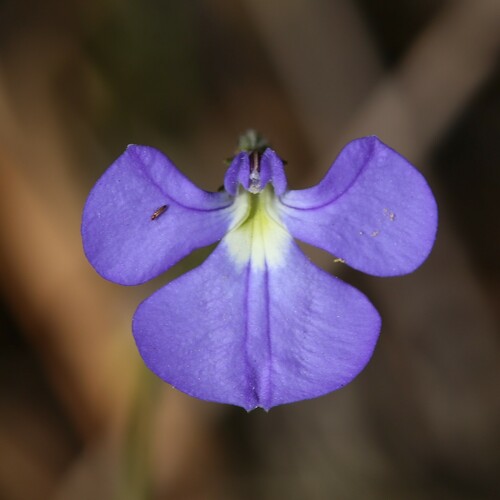
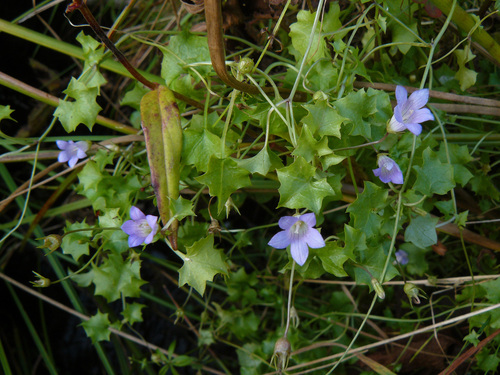
Hesperocodon hederaceus (L.) Eddie & Cupido, also previously called Wahlenbergia hederacea and commonly known as the ivy-leaved bellflower, is a flowering plant species found across Europe. It is a delicate, patch-forming, hairless perennial herb with thin creeping stems that reach around 20 cm in length. Its pale green leaves are long-stalked, ivy-shaped and rounded, with a cordate form, and measure approximately 5–12 mm in both length and width. In summer and autumn, it produces erect, solitary pale blue flowers. Each flower has a bell-shaped corolla with 5 short lobes, measuring 6–10 mm long by 5–8 mm wide, and grows on a fine stalk 1–4 cm long. It has been suggested that these long pedicels are an adaptation that helps with seed dispersal. This species grows in cool, moist, boggy, partially-shaded areas that usually have acidic soils. Common habitat types include woodlands, streamsides, pastures, heaths, and beside rivulets. It thrives in short-grassed areas next to streams with moist, acidic soil, and is almost never found in basic soils or stagnant water. It typically occurs in small, scattered groups. The population of ivy-leaved bellflower declined throughout the 1900s due to habitat loss. It is native to Europe, and is common in southern England and Wales. It can also be found in North West England, Western Scotland, Ireland, France, Belgium, Netherlands, Luxembourg, Western Germany, Spain, and Portugal.