About Hesperis matronalis L.
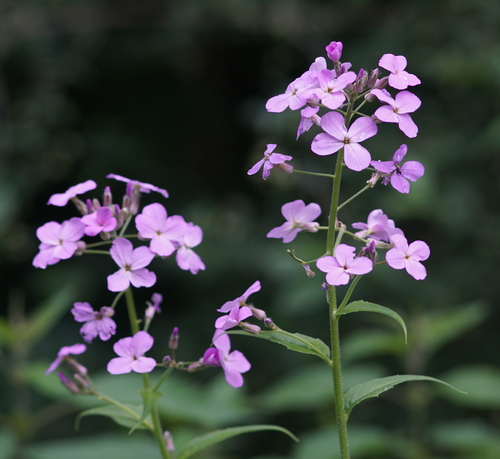
Hesperis matronalis L. grows to 100 centimeters or taller, with multiple upright, hairy stems. It is typically a biennial: it produces a mound of foliage in its first year of growth, and flowers in its second year. Some races are short-lived perennials. It produces showy blooms from early to mid spring. Its leaves are alternately arranged on upright stems and lanceolate-shaped; they usually have very short petioles or no petioles at all, with toothed margins (though margins can sometimes be entire), and are widest at the base. Short hairs cover both the top and bottom surfaces of the foliage, giving the leaves a somewhat rough texture. The largest leaves are around 12 cm long and over 4 cm wide. Early in spring, it forms a thick, low-growing mound of foliage. When flowering, the lower sections of stems are generally unbranched and have no foliage left, while the top of the blooming plant may grow a few branches that end in inflorescences. Plentiful, fragrant flowers grow in large, showy terminal racemes that can reach over 30 cm tall, and elongate as individual flowers on the inflorescence open. When stems hold both flowers and fruits, the weight can cause the stems to bend. Each flower is large, 2 cm across, and has four petals. Flower color varies: different shades of lavender and purple are most common, but white, pink, and even mixed-color flowers exist in cultivated forms, along with several different double-flowered varieties. The four petals are clawed and hairless. Flowers have six stamens arranged in two groups: the four closest to the ovary are longer than the two oppositely positioned ones. Stigmas are two-lobed. The four sepals are erect, form a mock tube around the claws of the petals, and share a similar color to the petals. Some plants can continue blooming until August, but warm weather greatly reduces how long each individual flower stays open. Seeds develop in thin, 5–14 cm long pod-shaped fruits, which hold two rows of seeds separated by a dimple. The fruits are terete, open via glabrous valves, and are constricted between seeds just like a pea pod. The oblong seeds are 3–4 mm long and 1–1.5 mm wide. In North America, Hesperis matronalis, commonly called dame's rocket, is often mistaken for native Phlox species, which also have similar large, showy flower clusters. The two can be told apart by differences to foliage and flowers: dame's rocket has alternately arranged leaves and four petals per flower, while phloxes have opposite leaves and five petals per flower. Hesperis matronalis is native to southern Europe, ranging from Spain to Turkey. It has been introduced to many other temperate regions around the world. It occurs as a garden escape in many areas of Ireland, including Belfast. It was brought to North America in the 17th century, has since naturalized there, and now grows across most of the United States and Canada. The United States Department of Agriculture website hosts a map showing the states and provinces where the plant has been recorded. In Europe, it acts as a host plant for caterpillars of several butterfly species: the orange tip (Anthocharis cardamines), large white (Pieris brassicae), small white (Pieris rapae), and caterpillars of the moth Plutella porrectella. Hesperis matronalis has been cultivated as a garden species for a long time. It grows best in full sun to partial shade, in moist, well-drained soils. It is low-maintenance, self-seeds quickly, and forms dense stands. Extensive single-species stands of dame's rocket are visible from far away. When growing outside of cultivated areas, these dense stands can crowd out native plant species. Its successful spread across North America is credited to its high seed production, and the fact that its seeds are often included in prepackaged wildflower seed mixes sold for naturalizing projects. It typically grows as a low-lying foliage rosette in its first year; in following years, flowering and seed production happen at the same time throughout the blooming season. This species is commonly found in roadside ditches, dumps, and open woodland settings, where it is noticeable when in bloom. While it makes an attractive, hardy garden plant, it has been found to be ecologically invasive in North America. It is propagated by seeds, but desirable individual plants, including double-flowering forms, are propagated from cuttings or by dividing clumps. Young leaves of Hesperis matronalis are high in vitamin C, slightly bitter, and can be eaten in salads or cooked. They are available during winter in temperate climates, when few other leafy greens can be harvested. Tender spring shoots, when cooked, are considered an excellent vegetable. Flower buds are also eaten, and open flowers are used to add a spicy flavor and bright color to dishes. The plant's seeds can also be sprouted and eaten in salads.