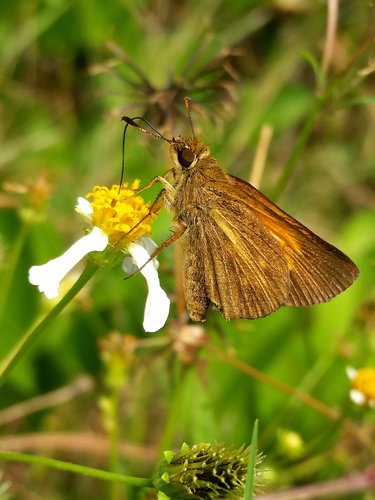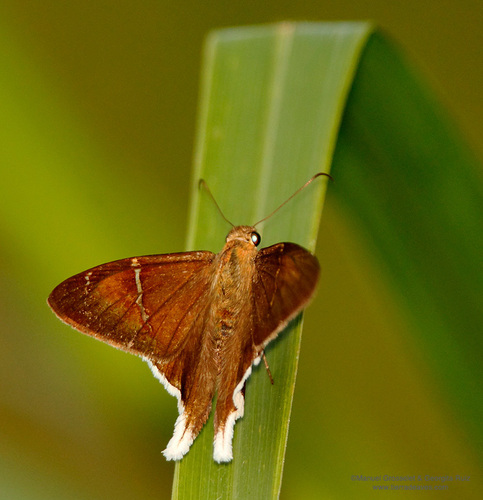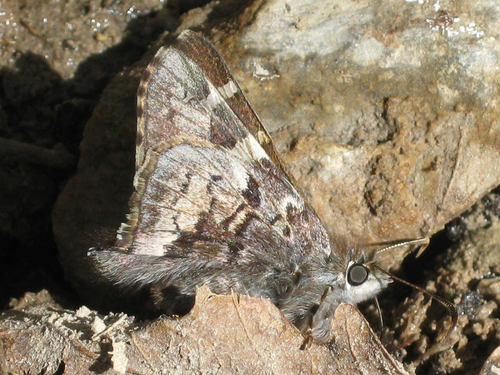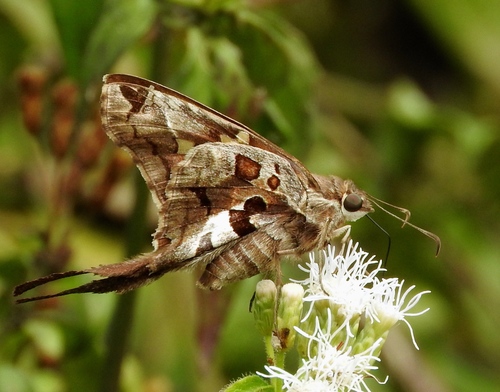
About Hesperia comma assiniboia (Lyman, 1892)
Hesperia comma is a butterfly species belonging to the family Hesperiidae. It holds two different common names across regions: it is called silver-spotted skipper in Europe, and common branded skipper in North America. This name difference exists because a separate North American spread-winged skipper species, Epargyreus clarus, also uses the common name "silver-spotted skipper".
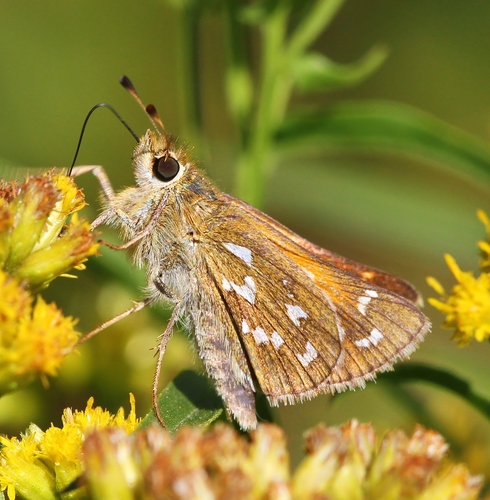
This species is often mistaken for the large skipper, Ochlodes sylvanus. It can be easily distinguished from the large skipper by the numerous white spots on the underside of its hindwings, and the darker tips on its upper forewings compared to the large skipper. Their flight periods also rarely overlap: in Britain, the large skipper's flight season is almost entirely over by August, when the silver-spotted skipper begins flying. The silver-spotted skipper prefers warm calcareous habitats. It has a broad overall distribution: its range extends south to North Africa, north through Europe to the Arctic, and east across Asia to China and Japan. It also has subspecies present in North America, including the subspecies Hesperia comma assiniboia (Lyman, 1892). In the United Kingdom, this species is rare, and restricted to the chalk downlands of southern England.
During August and September, females lay single eggs on the leaf blades of sheep's fescue, Festuca ovina, which is the species' only foodplant. They will occasionally lay eggs on nearby plants instead. Females are very selective about their egg-laying sites: most eggs laid in the UK are placed in short turf no taller than 4 cm, and often located beside patches of bare ground. The species overwinters in the egg stage, and eggs hatch in March. Like other skipper species, the larvae build small tent-like structures from leaf blades and silk, and feed from within these structures. After 14 to 15 weeks, larvae enter the pupal stage at the base of their foodplant. Pupation lasts 10 to 14 days, and like most butterfly species, adult males emerge before adult females.