About Hesperaloe parviflora (Torr.) J.M.Coult.
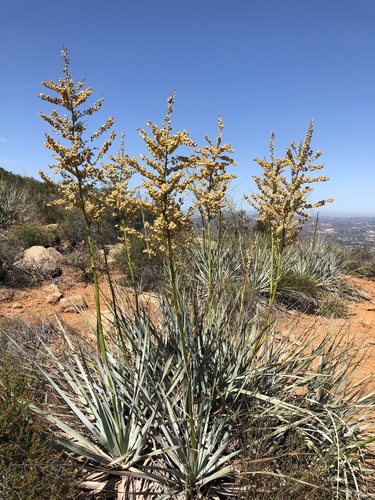
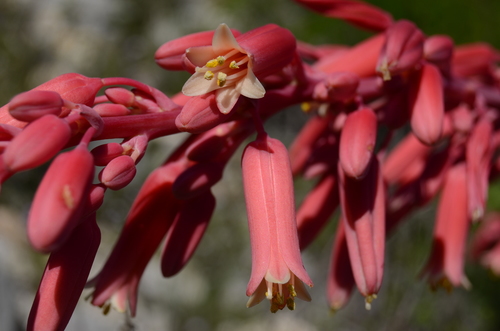
Hesperaloe parviflora (Torr.) J.M.Coult., commonly known as red yucca, hummingbird yucca, redflower false yucca, and samandoque, is an evergreen succulent plant belonging to the Asparagaceae family, subfamily Agavoideae. It is native to the Chihuahuan and Coahuilan deserts of Northern Mexico, and to Central, Southern, and Western Texas. In its native range, it can be found in the Maderas del Carmen Protected Area in Coahuila just south of Big Bend National Park, where it also occurs; in Texas, it grows as far north as Lubbock and the Dallas-Fort Worth area, and as far east as Tyler. It has additionally been sighted outside its native range in Pueblo, Colorado, and Shreveport, Louisiana. Today, this species is widely cultivated. It is commonly planted in groups along roadsides, in public spaces, and for exterior landscaping around corporate or office buildings. It is also popular among plant collectors and private gardeners who use water-wise gardening methods, and is especially favored for xeriscaping in its native Texas and northern Mexico. It is now grown frequently across Southern California, the San Francisco Bay Area, parts of southern Nevada including Henderson and Paradise, the Albuquerque, New Mexico area, and multiple Mexican cities including Hermosillo, Mexicali, Monterrey, and Saltillo. This plant grows in clumps that reach 3–6 ft (0.91–1.83 m) in both height and width. It has narrow, funnel-shaped evergreen leaves with slightly sharp tips, and a fringe of white thread-like fibers along the leaf edges, similar to fibers seen on related species such as Agave filifera and A. schidigera. From late spring to midsummer, it produces vibrant red or yellow tubular flowers held on branching reddish-tinted inflorescences that can grow up to 1.5 m (5 ft) long. These blooms are often considered a garden highlight, described as looking like a natural fireworks display, and are very popular with pollinators, especially hummingbirds. After pollination, flowers develop into woody seedpods that resemble pistachios. These seedpods hang on the dried inflorescence until they break or fall off, and can lie dormant for many months after detaching until rain or other moisture reaches their desert habitat. The Latin specific epithet parviflora translates to "with small flowers". This species has multiple advantages for gardeners. It is naturally drought tolerant, thrives in high temperatures and bright hot sun, and is adapted to withstand winter temperatures at or below freezing. It is also popular for its distinct architectural form, its ability to attract pollinators via its flowers, and its overall low maintenance requirements. Though its leaf tips are slightly sharp, they are blunted, making this a much less intimidating and problematic garden plant compared to many species in related genera such as Agave, Yucca, and former Sansevieria (now classified as Dracaena), which typically have needle-sharp and sometimes serrated foliage. Hesperaloe parviflora also does not produce new offshoots (pups) nearly as prolifically as these related genera, and grows at a steadier, more manageable rate.