About Herpestes urva (Hodgson, 1836)
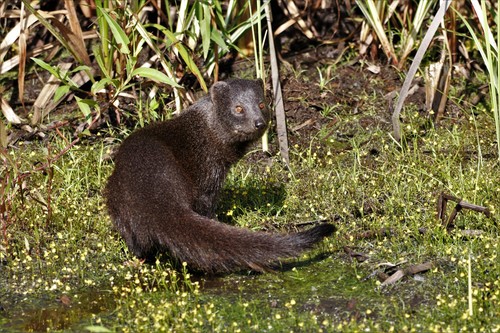
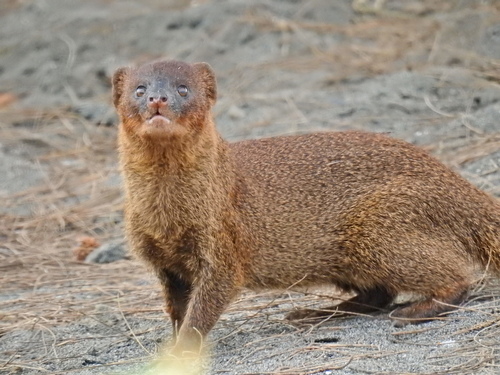
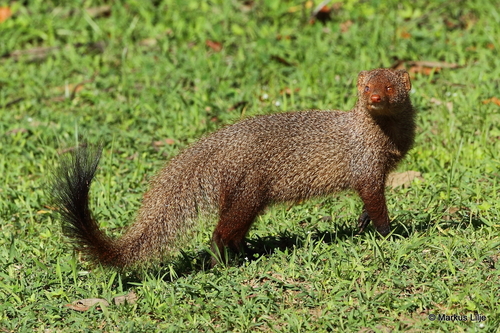
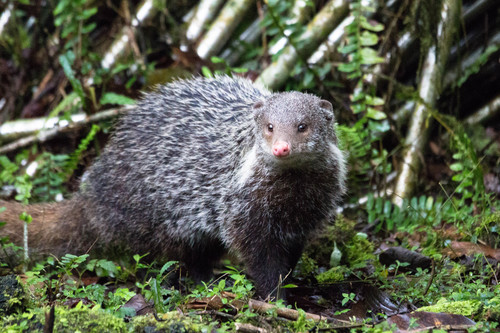
The crab-eating mongoose, scientifically named Herpestes urva (Hodgson, 1836), has the following physical characteristics. Its sides are grey, while its neck, chest, belly, and limbs are dusky brown. A broad white stripe runs along the sides of its neck, extending from the cheeks to the shoulder. It has white specks on the top of its head, a white chin, and a grey throat. Its iris is yellow, and its ears are short and rounded. It has webbing between its digits. Its head-to-body length ranges from 47.7 to 55.8 cm (18.8 to 22.0 in), and it has a bushy tail that measures 28 to 34 cm (11 to 13 in) long. Its body weight ranges from 1.1 to 2.5 kg (2.4 to 5.5 lb).
Regarding distribution and habitat, the crab-eating mongoose is found in northeastern India, northern Myanmar, Thailand, Peninsular Malaysia, Laos, Cambodia, and Vietnam; it is rare in Bangladesh. It has been recorded at altitudes ranging from sea level up to 1,800 m (5,900 ft). In Nepal, it lives in subtropical evergreen and moist deciduous forests, and has also been spotted on agricultural land near human settlements. In India, it has been recorded in the states of Assam, Arunachal Pradesh, and Uttarakhand. In Bangladesh, it has been recorded in the eastern forested hills of the Sylhet and Chittagong areas. In Myanmar, it was recorded in the Bumhpa Bum hills up to 930 m (3,050 ft) in altitude, as well as in Hukawng Valley, Alaungdaw Kathapa National Park, Bago Yoma, and Myinmoletkat Taung during surveys conducted between 2001 and 2003. In China, it was recorded in the subtropical limestone forests of Guangxi, Guangdong, and Hainan provinces during interview and camera-trapping surveys carried out between 1997 and 2005.
For ecology and behaviour, crab-eating mongooses are usually active during the morning and evening, and have been observed in groups of up to four individuals. They are considered good swimmers, and they hunt along stream banks and close to bodies of water. Despite their common name, their diet is not limited to crabs; they eat almost anything they can catch, including fish, snails, frogs, rodents, birds, reptiles, and insects.