About Herpestes ichneumon (Linnaeus, 1758)
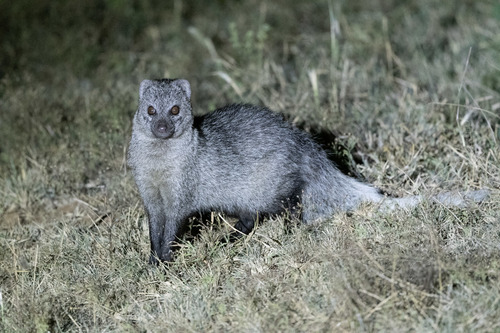
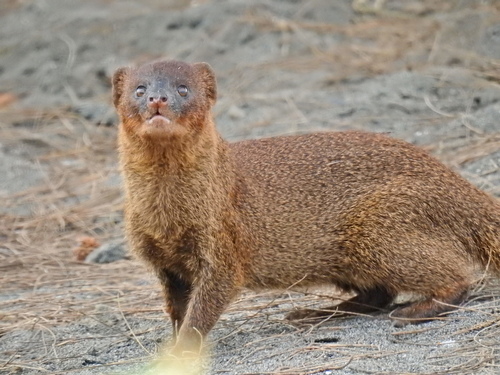
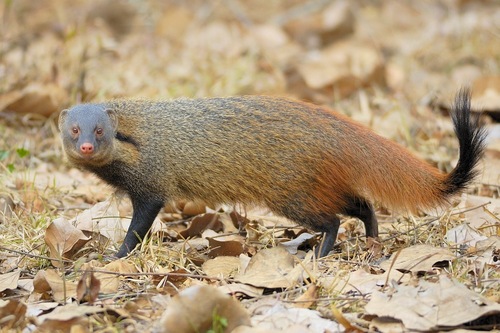
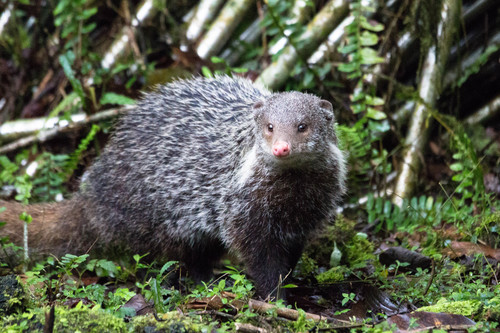
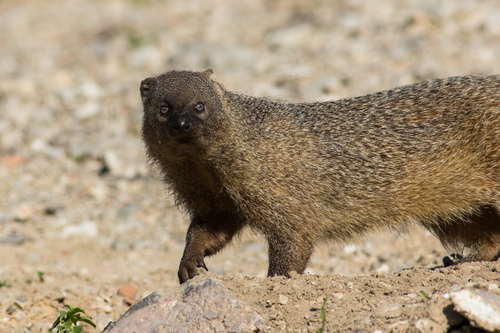
The Egyptian mongoose, Herpestes ichneumon (Linnaeus, 1758), has long, coarse fur colored grey to reddish brown, marked with flecks of brown and yellow. It has a pointed snout, small ears, and a slender body that measures 48–60 cm (1 ft 7 in – 2 ft 0 in) in length. Its tail is 33–54 cm (1 ft 1 in – 1 ft 9 in) long and tipped with black. Its hind feet and a small area around its eyes are hairless. It has 35–40 teeth, with highly developed carnassials adapted for shearing meat. Adult individuals weigh between 1.7–4 kg (3.7–8.8 lb). Sexual dimorphism has been observed in Portuguese populations, where some females are smaller than males. Females have 44 chromosomes, while males have 43, because one Y chromosome has translocated to an autosome.
The Egyptian mongoose lives in swampy and marshy habitats near streams, rivers, and lakes, as well as in coastal areas. In the Iberian Peninsula, where it inhabits maquis shrubland, it prefers areas close to rivers with dense vegetation. It does not live in deserts. In the Iberian Peninsula, it has been recorded from north of the Douro River to the south in Portugal, and from the central plateau through Andalucía to the Strait of Gibraltar in Spain. In North Africa, it occurs along the Mediterranean coast and in the Atlas Mountains from Western Sahara, Morocco, Algeria, and Tunisia east into Libya, and from northern Egypt across the Sinai Peninsula. In 1993, one individual was observed in Egypt’s Faiyum Oasis, and its tracks were recorded that same year in coastal sand dunes near Sidi Barrani. In the late 1990s, an individual was spotted on an island in Lake Burullus in the Nile Delta during an ecological survey. Surveys carried out between 2012 and 2016 recorded the species in the Gaza Strip and Jericho Governorate in the West Bank, Palestinian territories. In western Syria, it was observed in the Latakia Governorate between 1989 and 1995, and taxidermied specimens were sold in local shops. In southern Turkey, it has been recorded in the Hatay and Adana Provinces. In Sudan, it is found near human settlements along the Rahad River and in Dinder National Park; it was also recorded in the Dinder–Alatash protected area complex during surveys between 2015 and 2018. In Ethiopia, the Egyptian mongoose has been recorded at elevations of 2,000–3,000 m (6,600–9,800 ft) in the Ethiopian Highlands. In Senegal, one individual was observed in Niokolo-Koba National Park in 2000, a park dominated mainly by open grassland habitat. The first confirmed record of the species in Guinea’s National Park of Upper Niger came from surveys in spring 1997, which found dead Egyptian mongooses for sale as bushmeat in villages near the park. In Gabon’s Moukalaba-Doudou National Park, it has only been recorded in savanna habitats. In the Republic of Congo, it was repeatedly observed in the Western Congolian forest–savanna mosaic of Odzala-Kokoua National Park during 2007 surveys. In the 1990s, it was considered a common species in Tanzania’s Mkomazi National Park.
The Egyptian mongoose is diurnal. In Doñana National Park, researchers have observed solitary individuals, pairs, and groups of up to five individuals. Adult males exhibit territorial behavior, and share their home ranges with one or multiple females. The home ranges of adult females overlap to some degree, except for the core areas where they raise their offspring. It preys on rodents, fish, birds, reptiles, amphibians, and insects, and also feeds on fruit and eggs. To crack open eggs, it throws them between its legs against a rock or wall. In 1985, 30 Egyptian mongooses in Doñana National Park were radio-tracked and their faeces collected. These samples contained remains of European rabbit (Oryctolagus cuniculus), sand lizards (Psammodromus), Iberian spadefoot toad (Pelobates cultripes), greater white-toothed shrew (Crocidura russula), three-toed skink (Chalcides chalcides), dabbling ducks (Anas), western cattle egret (Bubulcus ibis), wild boar (Sus scrofa) meat, Algerian mouse (Mus spretus) and rat species (Rattus). Research in southeastern Nigeria found that it also feeds on giant pouched rats (Cricetomys), Temminck's mouse (Mus musculoides), Tullberg's soft-furred mouse (Praomys tulbergi), Nigerian shrew (Crocidura nigeriae), Hallowell's toad (Amietophrynus maculatus), African brown water snake (Afronatrix anoscopus), and Mabuya skinks. It attacks and feeds on venomous snakes, and is resistant to the venom of Palestine viper (Daboia palaestinae), black desert cobra (Walterinnesia aegyptia) and black-necked spitting cobra (Naja nigricollis). It has been recorded less frequently in areas of Spain where the Iberian lynx has been reintroduced.
Captive male and female Egyptian mongooses reach sexual maturity at two years of age. In Doñana National Park, courtship and mating occur in spring, between February and June. After an 11-week gestation period, two to three pups are born between mid-April and mid-August. Pups are hairless at birth, and open their eyes after about one week. Females care for their pups for up to one year, and occasionally longer. Pups begin foraging independently at four months of age, but will still compete for food brought back to them after this age. Wild Egyptian mongooses probably live up to 12 years of age. One captive individual lived to be over 20 years old. The species’ average generation length is 7.5 years.