About Hernandia nymphaeifolia (C.Presl) Kubitzki
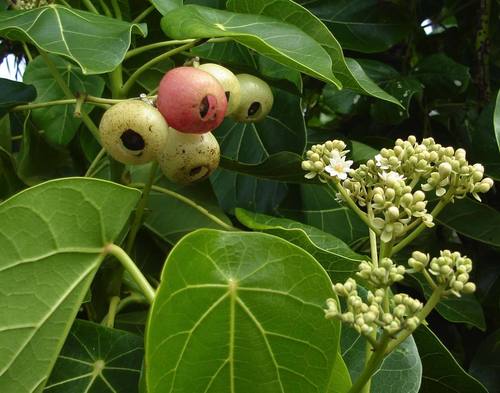
Hernandia nymphaeifolia (C.Presl) Kubitzki is a tree that grows between 5 and 22 meters tall. Its leaves are narrowly or broadly ovate, or subcircular, with 5 to 9 palmate veins. The flowers are white or greenish, hermaphrodite, fragrant, and male and female flowers are separated. It produces fleshy fruit that is waxy red or white. This species grows throughout the tropics, and is found exclusively in coastal habitats: along sea-shores in littoral forest, and in coastal swamps. In the Mariana Islands, H. nymphaeifolia is recorded to have its seeds dispersed by the Marianas flying fox. It is one of the most common beach tree species in New Ireland. The wood of H. nymphaeifolia is light and perishable. Across South Pacific islands, it has been used for fishing rods, fish net floats, wooden sandals, fan handles, drawing boards, canoe accessories, furniture, and firewood. A woody layer surrounds the seed of this tree (also called the lantern tree). Tahaitians polish the round brown seeds to a high gloss and shape them into necklaces. Marshallese people bathe children in a healing bath prepared from H. nymphaeifolia leaves, and use preparations from other parts of the tree to relieve headaches. Scientific study has been conducted on the effect of lignans from this species on Ca2+ signaling in human neutrophils. In parts of New Britain and Vanuatu, its wood is used to make canoe hulls. In New Britain, the Nakanai people also use its wood to make hourglass drums. On Waya Island, Fiji, the flowers are used to treat asthma.