About Heritiera littoralis Dryand. ex Aiton
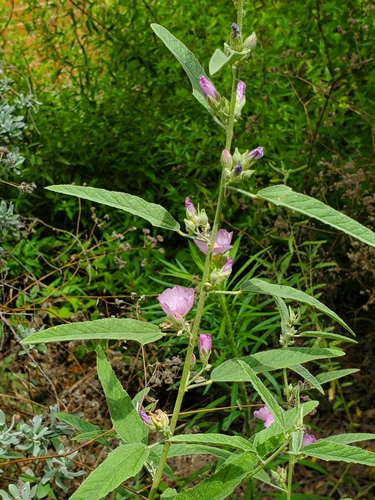
Heritiera littoralis Dryand. ex Aiton is an evergreen tree that grows up to 25 m (82 ft) tall. It has very prominent, sinuous buttress roots that can reach up to 1 m (3 ft 3 in) in height. The tree is typically low-branching, with an untidy-looking crown and gnarled branches. Its trunk is light grey to grey-brown; it is smooth when young, and develops vertical fissures as it ages.
Leaves are arranged spirally along the branches. They range in size from 20 by 10 centimetres (7.9 by 3.9 in) up to 30 by 15 centimetres (11.8 by 5.9 in), with a petiole up to 2 cm (0.79 in) long. The leaves are shaped oblong-elliptical to ovate-elliptical; their upper surface is dark green, while their undersides are silvery-white to light brown, covered in stellate scales.
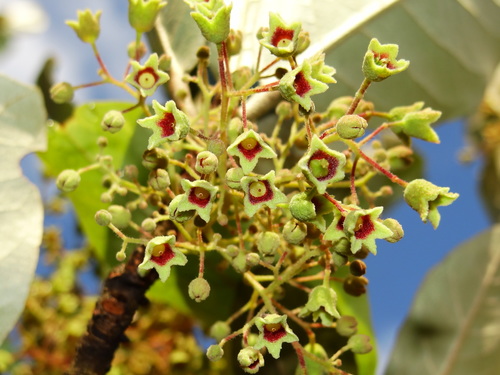
This species is monoecious, meaning individual plants bear both functionally female pistillate and functionally male staminate flowers. Its inflorescences are axillary panicles. The flowers are bell-shaped (giving the species its common name Tulip oak), with a fused perianth tube that usually has 5 teeth. They are greenish-pink or dull purple, and measure around 6 mm (0.24 in) wide and long.
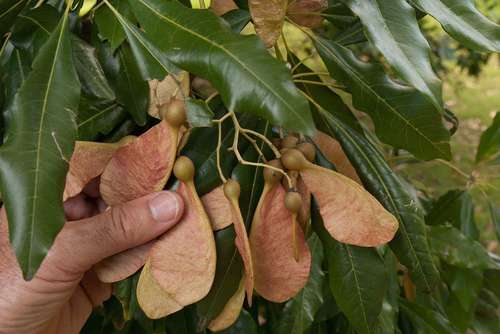
The fruit is a flattened, ellipsoid, indehiscent, brown woody pod that develops from the carpel, and holds a single seed. It has a distinct oblique keel on its uppermost side, and grows up to 10 cm (3.9 in) long by 6 cm (2.4 in) wide. The fruit can float for several weeks, allowing tides, currents, and winds to aid its dispersal.
Heritiera littoralis's natural range covers eastern Africa, Madagascar, India, Southeast Asia, Melanesia, and the Northern Territory and Queensland in Australia. It grows on the landward edges of mangrove forests and along riverine forests, at elevations close to sea level.
This species acts as a host for the larvae of multiple lepidopteran species: Arhopala micale, Arhopala pseudocentaurus, Assara seminivale, Hymenoptychis sordida, and Synnympha perfrenis.
Heritiera littoralis is harvested for timber, which is valued for its toughness, durability, and resistance to saltwater. The timber is commonly used in shipbuilding, and for making pilings, bridges, wharves, furniture, and housing. When the trunk is sufficiently straight and tall, it has been used for ship's masts. Fruits from species in this genus are used in Philippine cuisine to neutralize fishy taste in kinilaw, a local dish of raw fish prepared in vinegar or citrus juices; another species used for this purpose is the fruit of the tabon-tabon tree (Atuna excelsa subsp. racemosa, synonym Atuna racemosa).
Traditional uses of this plant include extracts to treat diarrhea and dysentery, and sap as poison for fish, arrowheads, and spearheads. In the Nicobar and Andaman islands, the plant's leaves and seeds are considered edible. Twigs have been used for cleaning teeth and for chewing.