About Hericium abietis (Weir ex Hubert) K.A.Harrison
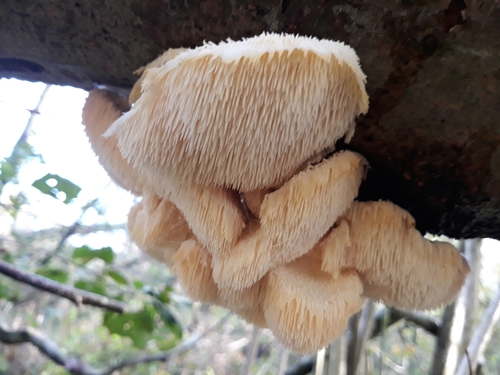
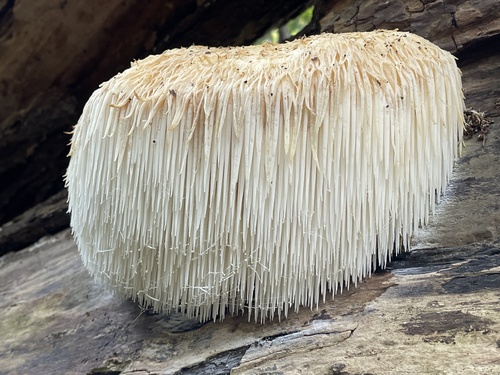
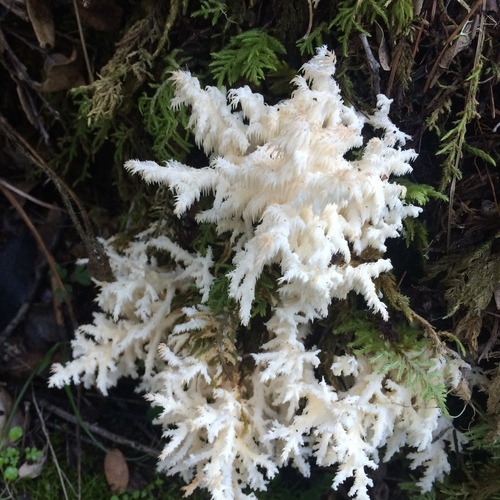
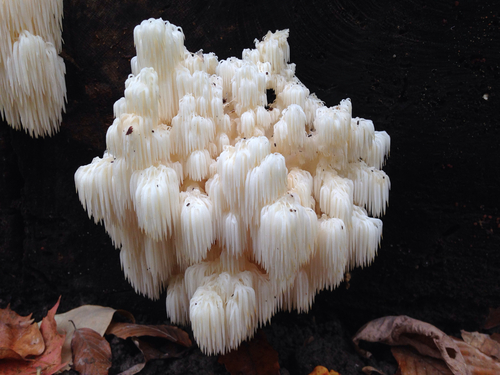
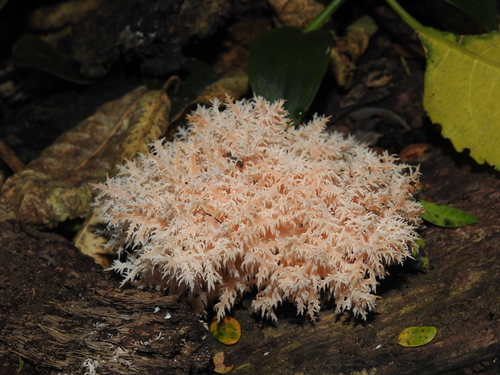
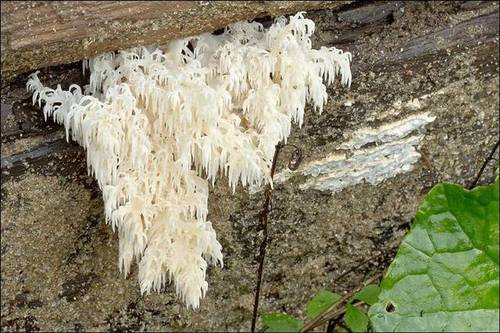
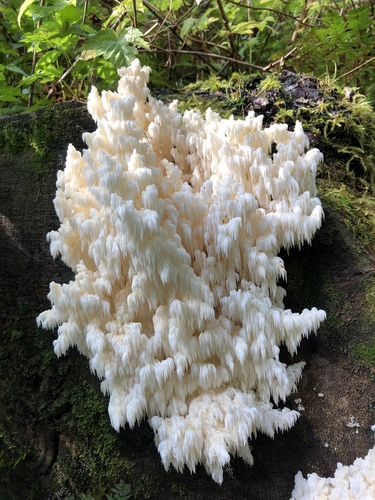
The scientific name of this species is Hericium abietis (Weir ex Hubert) K.A.Harrison. Its fruit body is a compact, branched mass that grows from a thick, tough base, with long spines hanging downward. The color of the fruit body ranges from white to creamy, light yellowish, and finally to salmon-buff. The hanging spines are typically 0.5–1 cm (1⁄4–3⁄8 in) long, though some may reach up to 2.5 cm (1 in) long; they are soft and brittle, and usually grow in clusters at the tips of the branches. Mature fruit bodies are most commonly 10 to 75 cm (4 to 30 in) wide and tall, but can reach very large sizes—one recorded specimen weighed approximately 100 pounds (45 kg). Hericium abietis produces a white spore print. Its spores are spherical or nearly spherical, smooth to slightly roughened, amyloid, and measure 4.5–5.5 by 4–5 μm. The hyphae are monomitic, meaning they consist only of generative hyphae, and have clamp connections. Hericium abietis causes white rot in conifers, a type of wood decay where the fungus selectively attacks lignin and hemicellulose in wood. Its fruit bodies grow singly, or occasionally in small groups, on dead conifer wood, especially that of Douglas-fir. It can also be cultivated on conifer sawdust or logs. This species is distributed across all of North America. Hericium abietis is an edible, choice mushroom. David Arora notes that cooked Hericium abietis has a flavor similar to fish, and that it is suitable for sauteing, marinating, or preparing as a curry dish.