About Heptapleurum arboricola Hayata
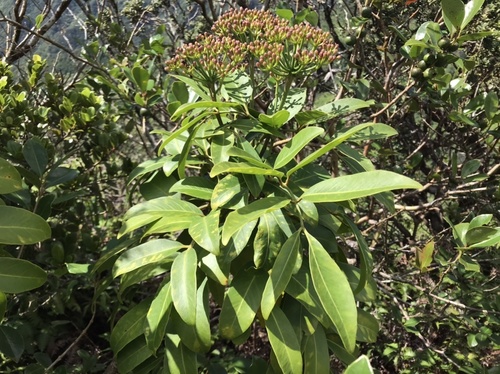
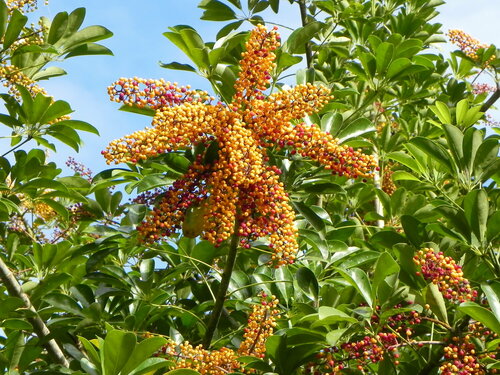
Heptapleurum arboricola Hayata is an evergreen shrub that grows 8 to 9 meters tall. It can grow as a free-standing plant or cling to the trunks of other trees as an epiphyte. Its leaves are palmately compound, with 7 to 9 leaflets per leaf. Mature leaflets measure 9 to 20 centimeters long and 4 to 10 centimeters wide, and are often smaller when the plant is grown in cultivation. Each leaflet has a wedge-shaped base, smooth entire margin, and an obtuse or acute apex that is sometimes emarginate. Leaflets are leathery in texture; the upper surface is shiny green and glabrous, while the underside is somewhat lighter and matte. Young plants produce smaller leaves with fewer leaflets. Each leaflet has a central midrib that splits it into two halves, with between four and six additional orders of veins clearly visible up to the third order. Stipules merge with the petiole, which is 12 to 15 centimeters long. This species is native to Taiwan, and has been introduced to the Ryukyu Islands, Hawaii, Florida, Bermuda, and Jamaica. All parts of the plant contain calcium oxalate crystals, saponins, and terpenoids. These toxic compounds act as irritants for cats and dogs, causing swelling that can sometimes lead to breathing difficulties, mouth burning, difficulty swallowing, vomiting, diarrhoea, and itching. For humans, the plant is a low-severity poison and a skin irritant that can cause contact dermatitis. Heptapleurum arboricola is commonly grown as a houseplant, popular because it tolerates neglect and poor growing conditions. It is also grown as a landscape garden plant in mild climates where frosts are not severe. Many cultivars have been selected for variations in leaf color and pattern; they are often variegated with creamy-white to yellow edges or centers, and dwarf forms exist. The cultivar 'Gold Capella' has received the Royal Horticultural Society's Award of Garden Merit.