About Heptapleurum actinophyllum (Endl.) Lowry & G.M.Plunkett
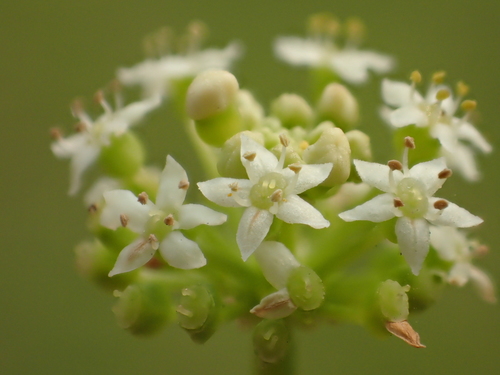
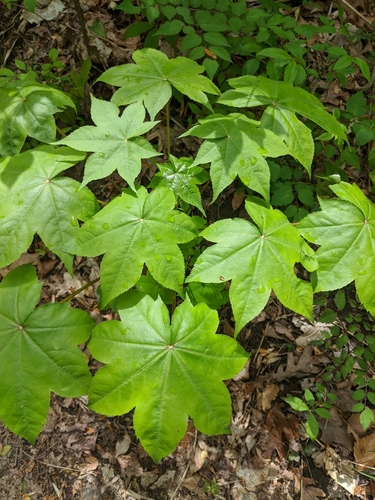
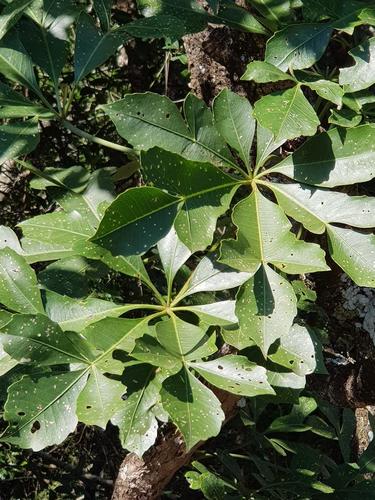
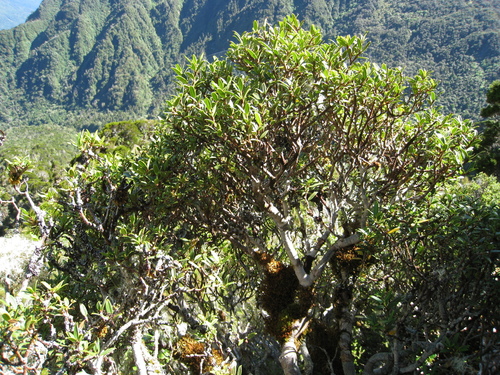
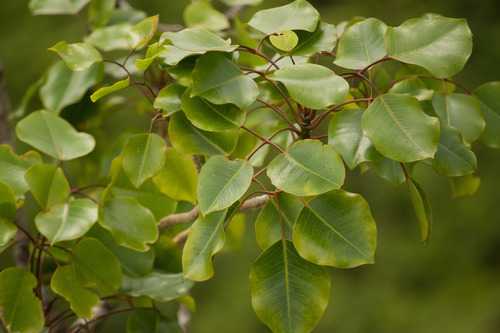
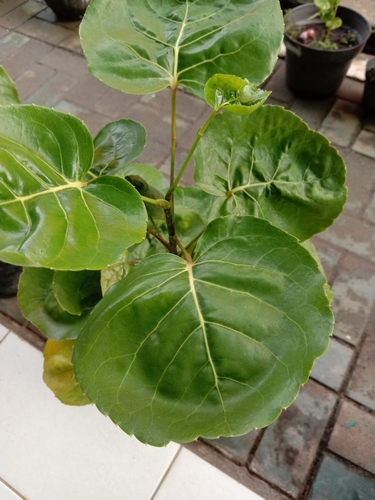
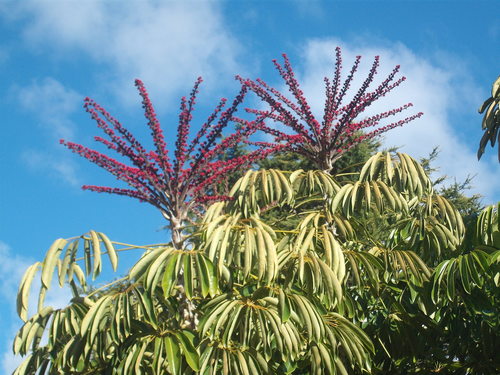
Heptapleurum actinophyllum is an evergreen tree that reaches up to 15 m (50 feet) in height. Its leaves are palmately compound, medium green, and typically arranged in groups of seven leaflets. This species is usually multi-trunked, and its flowers form at the crown of the tree. It often grows as a hemiepiphyte on other rainforest trees. It produces racemes that can grow up to 2 m (6.5 feet) long, each holding up to 1,000 small red flowers. Flowering starts in early summer and usually continues for several months. Its specific epithet actinophyllum translates to "with radiating leaves". In its ecology, the up to 1,000 flowers this plant produces create large volumes of nectar, which attracts nectar-feeding birds that act as pollinators. Many species of birds and animals eat its fruits, including musky rat-kangaroos, red-legged pademelons, and spectacled flying foxes. The leaves of this tree are a preferred food source for Bennett's tree-kangaroos. For cultivation, Heptapleurum actinophyllum is commonly grown as a decorative tree in larger gardens in mild to warm climates. When mature, it bears red flower spikes that hold up to 20 racemes, which develop in summer or early autumn. It can be propagated by either seed or cuttings. It grows best in well-drained soil, and only requires occasional watering and feeding to thrive. Despite this, it is an aggressive plant whose roots can outcompete and dominate surrounding soil. In some regions such as Florida and Hawaii, USA, it is classified as an invasive weed, and planting it is highly discouraged. With a minimum tolerated temperature of 13 °C (55 °F), juvenile specimens of this tree are grown as houseplants in temperate regions. This plant has received the Royal Horticultural Society's Award of Garden Merit.