About Heniochus monoceros Cuvier, 1831
Species Naming and Size
The masked bannerfish (scientific name Heniochus monoceros Cuvier, 1831) is a small-sized fish that can reach a maximum length of 23 centimetres.
Body and Dorsal Fin Shape
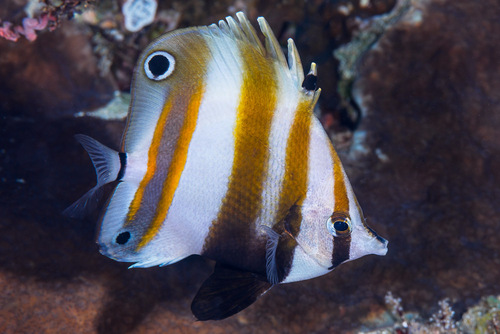
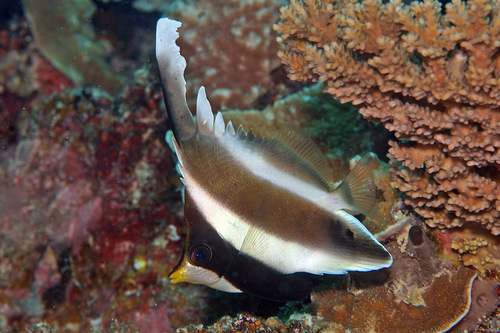
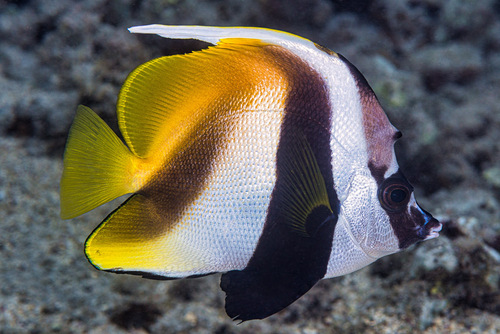
Its body is laterally compressed, and the first rays of its dorsal fin extend into a white filament outlined with yellow.
Base Body Color and Band Pattern
The base body color is white, marked with two vertical black bands.
First Black Band Details
The first band covers the fish's face, starting at its mouth and running to the base of the first dorsal fin rays, encompassing its snout and eyes.
Facial Markings
The fish's lips are white; a whitish band runs between its eyes, and an additional whitish band sits on top of its eyes.
Forehead Feature
The masked bannerfish has a small growth on its forehead axis, from which a bright whitish to yellowish area radiates out.
Second Black Band Placement
The second black band is located exactly in the middle of the fish's side.
Posterior Yellow Area
A yellow area extends from the posterior edge of the second black band to the middle of the anal fin, including the dorsal and caudal fins along the way.
Variable Body Blotch
Within this yellow area, close to the caudal peduncle, there is a brown-yellow blotch that varies in size between individual fish.
Geographical Distribution
The masked bannerfish is widespread across tropical and subtropical waters of the Indo-Pacific region, ranging from the eastern coast of Africa to Polynesia, and from southern Japan to New Caledonia.
Habitat and Depth Range
It typically lives on external reef slopes and in coral-rich lagoons, at depths between 2 and 30 metres (6 feet 7 inches to 98 feet 5 inches).