About Hemorrhois ravergieri (Ménétries, 1832)
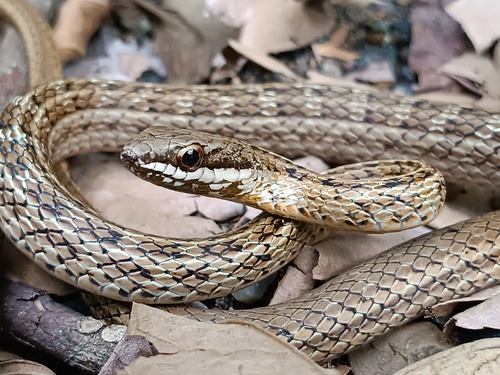
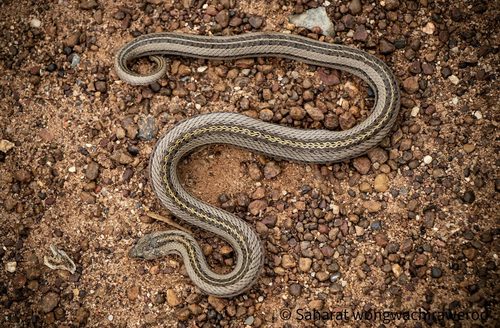
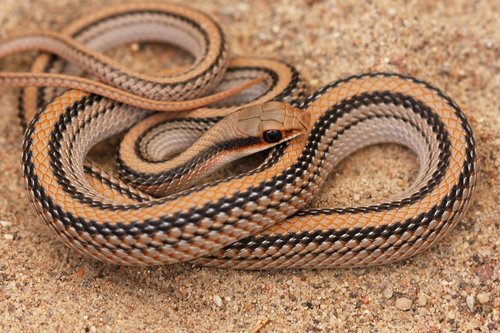
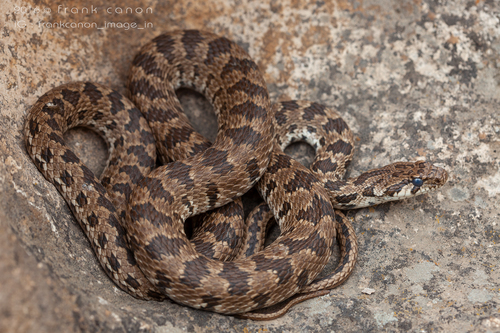
Hemorrhois ravergieri, also called H. ravergieri, has a dorsal base color of tan or grayish. It has a series of dark rhomboidal spots or crossbars along its back that alternate with smaller spots on its sides. These spots usually grow confluent towards the posterior end of the body, and appear as dark stripes along the tail. There is a diagonal dark streak below the eye, and a similar, subparallel streak that runs from the back of the eye to the corner of the mouth. On the ventral side, the snake is whitish, or it may be covered with blackish dots. Its weakly keeled dorsal scales are arranged in 21 rows. Ventral scales are obtusely angulate along the sides, and number between 190 and 222. The anal scale is divided, and the paired subcaudal scales number between 75 and 101. Fully grown adults can reach a total length of 133 cm (4 ft 4 in), with a tail that measures 32 cm (12+1⁄2 in) long. This species has been recorded from specific localities across a wide geographic range. In Greece, it is found on Kos. It occurs throughout the Middle East in Turkey, Iraq, Iran, Lebanon, Syria, Jordan, and Israel. It is also present in the former Soviet republics of the Caucasus and Central Asia; Central Asian populations stretch from the eastern shore of the Caspian Sea east to eastern Kazakhstan. In the Caucasus region, it lives in parts of Russia, Armenia, Georgia, and Azerbaijan. In Central Asia, it occurs in Kazakhstan, Turkmenistan, Uzbekistan, and Tajikistan. It ranges into South Asia in Afghanistan and Pakistan, and into East Asia in western Mongolia and northwestern China (Xinjiang).