About Hemorrhois nummifer (Reuss, 1834)
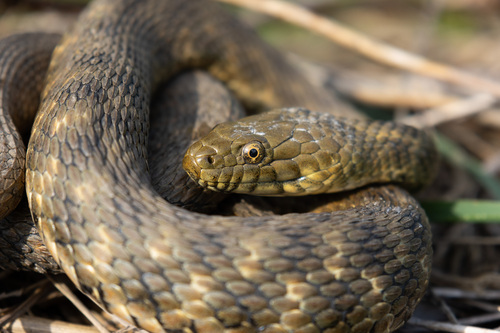
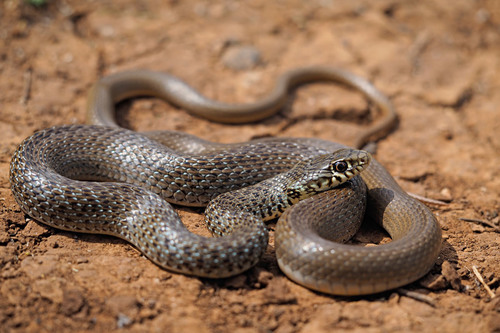
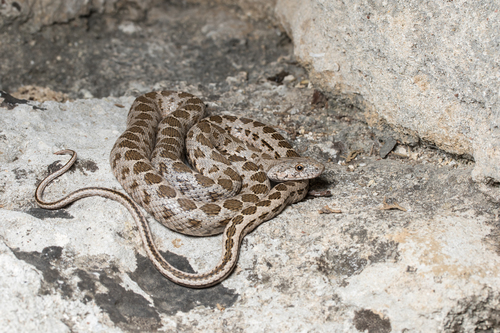
Hemorrhois nummifer, first formally described by Reuss in 1834, reaches a maximum total length of 100 cm (39 in), though most individuals are smaller. This snake has a strong, fairly robust body build. Its dorsal surface is colored brown, grey, or olive grey, and often features a dorsal row of 57 to 65 large spots. These large spots become a continuous stripe along the length of the tail. Smaller spots sit alongside the larger dorsal spots on the sides of the body, and the ventral belly surface is grey-white. This species has a wide distribution across Western and Central Asia: its range extends from Turkey south through Syria, Lebanon, northern and central Israel, Palestine, and western and northwestern Jordan, and east to Armenia, northern Iraq, northeastern Iran, Turkmenistan, southern Uzbekistan, Tajikistan, and Kyrgyzstan. It also occurs in extreme southeastern Europe, specifically on the Aegean islands of Greece including Kalymnos, Kos, and Lipsi, as well as on Cyprus. Isolated separate populations are found in northern Egypt, near Cairo and in the southern Sinai Peninsula. Hemorrhois nummifer lives in open areas, including open dry woodland and shrubland, that have some rocks and bushy vegetation. It is an adaptable species that can survive in both rural and urban environments. It is most commonly a lowland species, but has been recorded at elevations as high as 2,000 m (6,600 ft) in Turkey. This is a diurnal species that actively forages for prey; its diet consists mainly of small mammals, lizards, and small birds. It is harmless to humans, and uses Batesian mimicry by mimicking vipers in both appearance and behavior.