About Hemitriccus striaticollis (Lafresnaye, 1853)
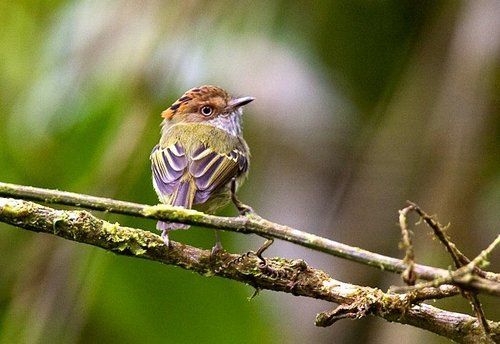
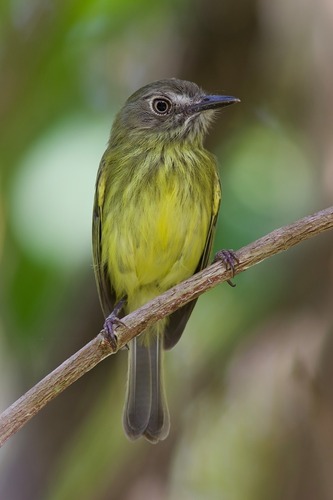
The stripe-necked tody-tyrant (Hemitriccus striaticollis) measures 11 to 12 cm (4.3 to 4.7 in) in length and weighs 7.8 to 11 g (0.28 to 0.39 oz). Males and females share identical plumage. Adults of the nominate subspecies have a grayish brown crown, a large white spot above the lores, a white eye-ring, and grayish brown ear coverts. Their back and rump are olive, their wings are olive with indistinct yellow edges on the flight feathers, and their tail is also olive. Their throat is white with distinct brownish streaks that extend onto the bright yellow breast. The rest of their underparts are mostly unstreaked bright yellow with a greenish tinge, and diffuse darker streaks on the flanks. Subspecies H. s. griseiceps differs from the nominate by having a gray crown and duller green upperparts. Both subspecies have a whitish to pale yellow iris, a blackish bill with a paler base to the lower mandible, and light gray legs and feet.
This species has a disjunct distribution, with the nominate subspecies occupying by far the larger range. The main population of the nominate subspecies lives in central and southern Amazonian Brazil, south of the Amazon River, ranging from the Madeira River east to Maranhão and south to the states of Mato Grosso, Goiás, and Minas Gerais. This range extends west through northern Bolivia and slightly into the Madre de Dios Department of southeastern Peru. Small separate populations of the nominate subspecies also occur in Peru's San Martín and Cuzco departments, along the border between Colombia's Meta and Guaviare departments, and in Bahia state in far eastern Brazil. Subspecies H. s. griseiceps has a very restricted range along the lower Tapajos River in Brazil's western Pará state.
The Amazonian population of the stripe-necked tody-tyrant primarily lives in somewhat open landscapes, including semi-humid to humid secondary woodland, thickets, and bamboo growing along watercourses. In Colombia and parts of Peru, the species occurs in the undergrowth of wooded savanna. Its elevation range reaches from sea level to 700 m (2,300 ft) in Brazil, up to 400 m (1,300 ft) in Colombia. In Peru, it occurs up to 1,000 m (3,300 ft) in San Martín Department, 500 m (1,600 ft) in Cuzco, and only 300 m (1,000 ft) in Madre de Dios.