About Hemitriccus granadensis (Hartlaub, 1843)
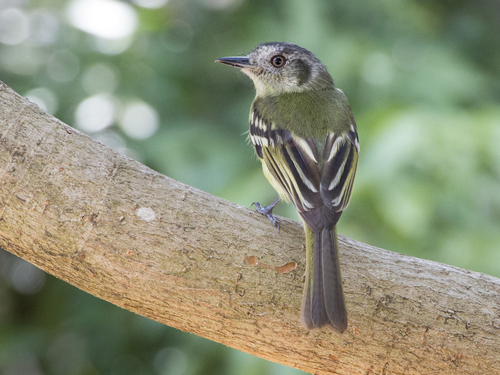
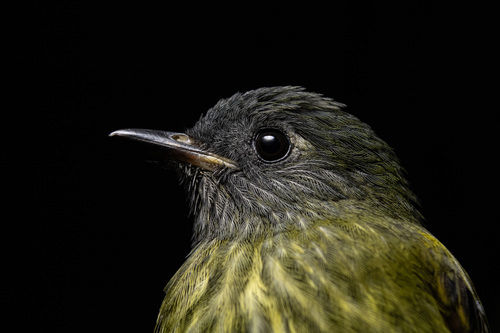
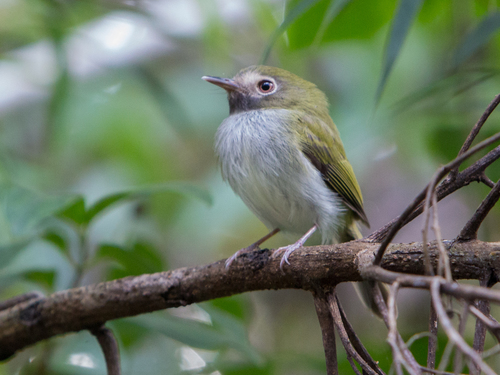
The black-throated tody-tyrant, Hemitriccus granadensis (Hartlaub, 1843), measures 8.5 to 11 cm (3.3 to 4.3 in) long and weighs 6.5 to 8.5 g (0.23 to 0.30 oz). Both sexes share identical plumage. Adults of the nominate subspecies H. g. granadensis have a dark olive crown, whitish lores and wide eye-ring, and grayish olive ear coverts. Their back and rump are dark olive; their wings are dark olive with indistinct yellow edges on the coverts, and their tail is dark dusky olive. Their upper throat and lower cheeks are sooty black, while their lower throat is whitish with grayish edges. A diffuse grayish band crosses the breast, fading to white on the lower breast and belly; their lower flanks and undertail coverts have a yellow tinge. All subspecies have a black bill and gray to pinkish gray legs and feet. Most have a highly variable iris color ranging from chestnut to pale orange. All other subspecies differ from the nominate and from each other as follows: H. g. lehmanni has a brighter, more yellowish green crown and upperparts than the nominate, along with buff lores and eye-ring, a brownish black throat, a brownish wash on the breast, and sometimes a pale iris. H. g. intensus is similar to lehmanni but has a blacker, less brownish throat, a pure gray breast, and a paler iris than the nominate. H. g. federalis has a whiter breast than the nominate. H. g. andinus has buffy lores and a grayish (not solid gray) breast. H. g. pyrrhops has a tawny-buff to deep cinnamon eye-ring. H. g. caesius has a pale ashy gray, grayish white, or buffy white eye-ring, and less extensive black on the throat than the nominate.
This species has a disjunct distribution, with each subspecies occupying its own separate range. H. g. lehmanni is found only in the isolated Sierra Nevada de Santa Marta in northern Colombia. H. g. intensus occurs in Serranía del Perijá, in Venezuela's Táchira state. H. g. federalis is found in Venezuela's Federal District. H. g. andinus ranges from the Norte de Santander and Santander departments in northeastern Colombia into Páramo de Tamá in western Táchira, Venezuela. H. g. granadensis occurs across all three Colombian Andes ranges, excluding the northern end of the eastern range, and extends south into northern Ecuador to Carchi Province on the Andes' western slope and to Napo Province on the eastern slope. H. g. pyrrhops lives on the eastern slope of the Andes from Morona-Santiago Province, Ecuador, south to Cuzco Department, Peru. H. g. caesius ranges from southeastern Peru's Puno Department into west-central Bolivia's La Paz and Cochabamba departments.
The black-throated tody-tyrant inhabits humid montane forest, cloudforest, and shrubby regenerating areas in the subtropical and temperate zones. It often favors somewhat open sites such as forest edges, overgrown tree falls, and landslide scars. Its elevation range is 1,500 to 3,500 m (4,900 to 11,500 ft) in Colombia, 1,700 to 3,000 m (5,600 to 9,800 ft) in Ecuador, 1,800 to 3,100 m (5,900 to 10,200 ft) in Peru, and 1,800 to 3,000 m (5,900 to 9,800 ft) in Venezuela.