About Hemistola chrysoprasaria (Esper, 1794)
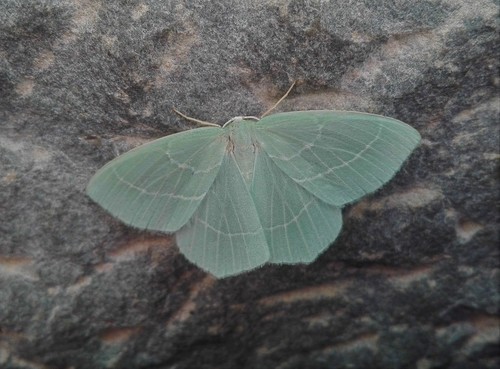
Hemistola chrysoprasaria (Esper, 1794) has a wingspan of 28–35 mm. Both the forewings and hindwings are light green when fresh, but fade to yellow-green then yellow-white as the moth ages. The forewings bear two white curved continuous cross lines: a faint inner (antemedian) line and a more distinct outer (postmedian) line. The antemedian line is strongly curved, and usually marked by two small, slight teeth pointing toward the wing tip; the postmedian line is nearly parallel to the forewing's distal margin, and has no teeth. The outer cross line continues onto the hindwing, and there is no discal stain. Male antennae are slightly combed, while female antennae are short and ciliate. Specimens from the Amur and Ussuri regions are often larger, with the cross lines more widely spaced than other populations. The subspecies lissas differs in the shape of the hindwing, which is rounded rather than elbowed. Fresh eggs are green, and turn dark just before hatching. Eggs are very flattened on both sides, with the egg pole positioned laterally. Caterpillars have variable cryptic coloration: they are green when young, turn brownish during hibernation, and become green again in spring. Pupae are green in colour.