About Hemisphaerota cyanea (Say, 1824)
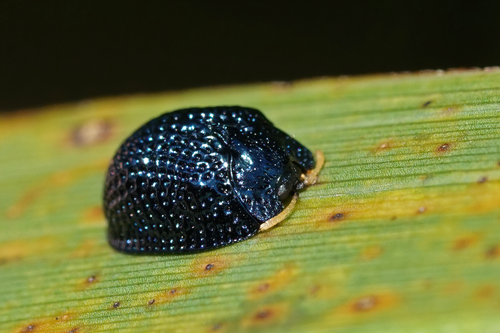
Hemisphaerota cyanea, commonly known as the palmetto tortoise beetle, is a small beetle that reaches 4.6–5.6 mm (0.18–0.22 in) in length. Its elytra (hardened outer wings) and pronotum (a prominent plate-like structure covering the thorax) are colored dark metallic blue or purple, and the species has an overall hemispherical dome shape. Its antennae are short, orange with black basal segments, and enlarged at the tips. The tarsi (the foot, or contact surface, of the leg) are large; each tarsi holds around 10,000 adhesive bristles, and each bristle has two terminal pads. The palmetto tortoise beetle is primarily distributed across the southeastern United States, with confirmed records in Florida, Georgia, Alabama, Texas, Louisiana, and Mississippi. It is most commonly found on the native saw palmetto, Serenoa repens, but also feeds and resides on the cabbage palm Sabal palmetto, the dwarf palmetto Sabal minor, and the scrub palmetto Sable etonia. Females lay yellow, elongated eggs between March and mid-April. They cement the eggs to host plant leaves and cover the eggs with a protective fecal covering that shields them from predators and parasitoids. After hatching, young larvae create a shield from fecal matter. Larvae have an "anal fork" that the fecal strands fasten to, holding the shield in place. This fecal thatch acts as an effective defense against predators like lady bugs and stink bugs. Larvae hide under this nest-like covering of thin fecal strands, and pupate inside these fecal shelters. While larvae cause some damage to host leaves, they rarely cause significant damage to host trees. When larvae reach maturity, they cling to the leaf surface and pupate under their fecal thatch, with new adults emerging one week later. Palmetto tortoise beetle larvae and pupae occur from mid to late summer, while adults can be found year-round. Adult beetles cling to palmetto fronds using thousands of microscopic bristles on their tarsi, paired with an oil that makes them very difficult to pry off the leaves. Both larvae and adults of Hemisphaerota cyanea feed on palmetto plants of the genus Sabal.