About Hemileccinum impolitum (Fr.) Šutara
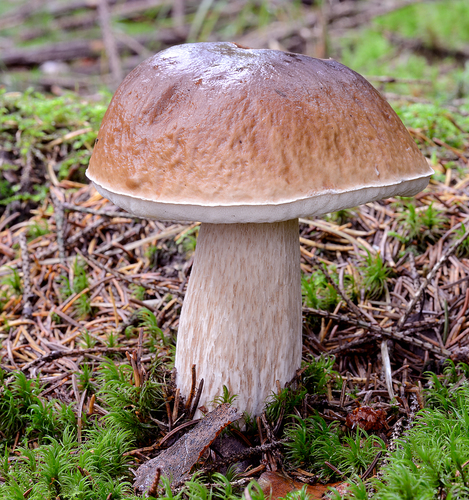
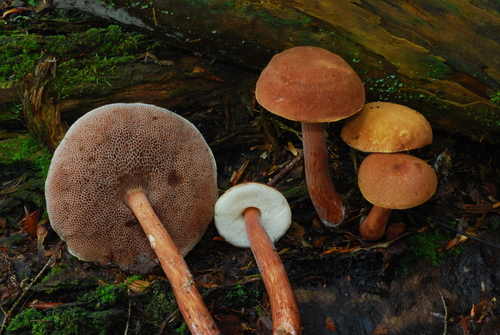
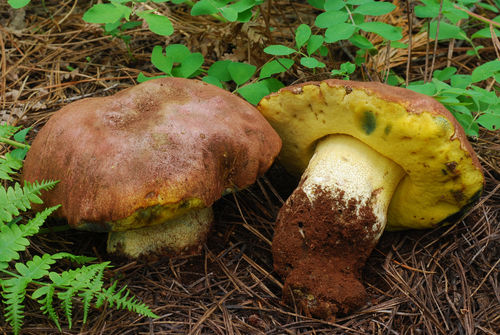
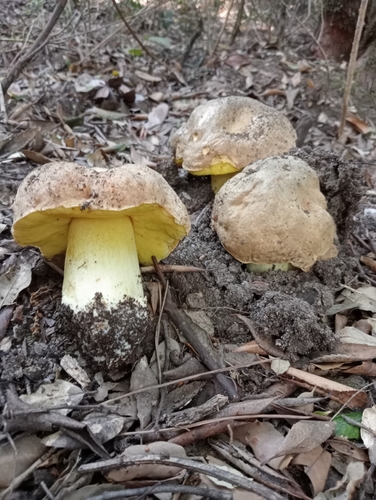
Hemileccinum impolitum (Fr.) Šutara is a bolete fungus with the following physical characteristics. The cap typically measures 5 to 12 cm (2 to 4.5 in) in diameter, and can grow as large as 20 cm (8 in). Young caps start hemispherical, gradually becoming convex as the fungus grows, and flatten out completely in fully mature specimens, sometimes with a slightly uplifted margin. Cap color ranges from light tan, pale brown, chestnut-brown, grey, ochraceous-brown, greyish-brown to olivaceous-brown. Young fruit bodies have a velvety, finely filamentous silvery-grey coating on the cap that disappears as the mushroom ages. A drop of ammonium hydroxide applied to the cap cuticle will turn it violet. The stem is cylindrical, club-shaped, or swollen in the middle, measuring 5 to 15 cm (2 to 6 in) tall and 2 to 6 cm (1 to 2.5 in) wide. Stem color is cream to pale yellow, typically lemon-yellow at the apex, and usually narrows at the base. It has no net-like reticulation, but is covered in tiny raised pustules called scabrosities below the apex, and sometimes turns brown with age. The internal tubes are pale yellow to lemon-yellow, and usually do not change color when cut, only rarely developing a faint greenish-brown stain. The pores are small and rounded, ranging from lemon-yellow to chrome-yellow; they do not change color when handled or injured, only rarely staining faintly greenish-brown. The flesh is thick and soft, ranging from pale yellow to whitish. It usually stays the same color when cut, and only rarely becomes faintly pinkish-brown above the tubes and at the stem base. It has a sour smell similar to iodine, which is more pronounced at the stem base. The spore print is olivaceous-brown. Spores are spindle-shaped (fusiform) or fusiform-ellipsoid, measuring 10–16 × 4–6 μm. While spores appear completely smooth under an optical microscope, scanning electron microscopy (SEM) reveals fine warts and tiny pin-prick indentations on their surface. The cap cuticle is a trichodermium, made up of cylindrical smooth hyphae with club-shaped terminal cells that collapse later in mature specimens. For distribution and habitat: Hemileccinum impolitum is ecologically versatile, forming ectomycorrhizal associations with multiple oak species (Quercus), and occasionally also with beech (Fagus) and chestnut (Castanea). It does not appear to be substrate-specific, and has been recorded growing on both calcareous and acidic soils. In the United Kingdom, it is found occasionally in southern England, though records also exist from other parts of the country. To date, molecular phylogenetic testing has confirmed its presence in Estonia, France, Germany, Portugal, Spain, Sweden, and the Mediterranean islands of Cyprus and Sardinia.