About Hemigalus derbyanus (Gray, 1837)
Base Fur Coloration
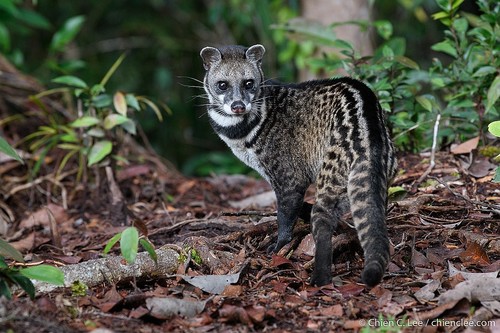
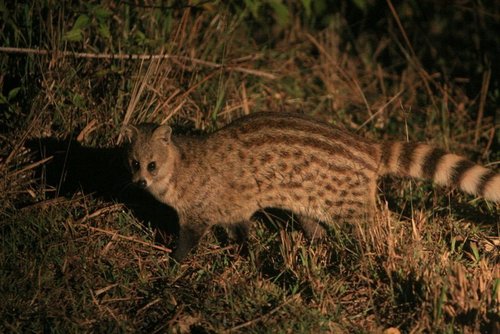
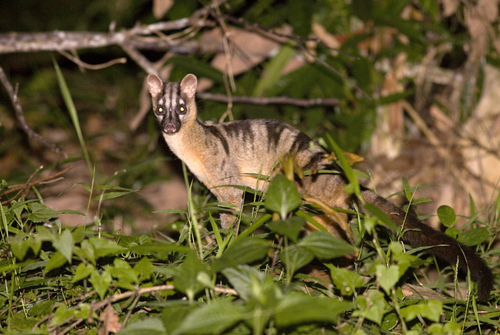
Hemigalus derbyanus, commonly called the banded palm civet, has pale base fur ranging from pale brown, grey, whitish or buff, and can also be yellowish.
Body Markings
It has between seven and eight dark bands across its face and back; these bands are typically dark brown, black, or chestnut.
Body Size and Weight
It is roughly the size of a domestic cat: excluding the tail, its body grows up to 53 cm (21 in) long, and it weighs between 1–3 kg (2.2–6.6 lb).
Tail Characteristics
Its tail is usually three-quarters the combined length of its head and body, and it swells in size when the civet responds to a threat.
Paw Sensory Adaptations
Sensitive hairs grow between the pads of its paws to help it sense prey.
Native Distribution Range
The banded palm civet is native to Myanmar, Thailand, Peninsular Malaysia, Sumatra, the Mentawai Islands and Borneo, where it occurs from sea level up to 1,660 m (5,450 ft) elevation.
Historical Myanmar Records
Between the early 20th century and the 1960s, only two individuals were recorded in Myanmar, both in the far south.
2022 Myanmar Sighting
In 2022, it was photographed for the first time in a reserved forest in Myanmar’s Tanintharyi Region.
Thailand Distribution Records
In Thailand, camera trap surveys conducted between 1996 and 2013 recorded the species in Khlong Saeng Wildlife Sanctuary, Khao Sok National Park, Kui Buri National Park and Hala-Bala Wildlife Sanctuary; all of these records came from evergreen forests at elevations between 162–695 m (531–2,280 ft).
Peninsular Malaysia Records
In 2011–2012 surveys, the species was recorded at just two locations in a hilly dipterocarp forest in Terengganu, Peninsular Malaysia.
Sumatra Lowland Records
In Sumatra, it has been recorded at 150 m (490 ft) in primary forest within Kerinci Seblat National Park, and at 800 m (2,600 ft) on Sumatra’s west coast.
Bukit Barisan Selatan Record
In 2011, it was photographed in primary evergreen forest at 800–1,089 m (2,625–3,573 ft) elevation in Bukit Barisan Selatan National Park.
Sumatra Forest Fragment Record
In 2015, it was recorded in forest fragments within an oil palm plantation adjacent to Kerinci Seblat National Park in South Solok Regency.
Singapore Extirpation
It was extirpated from Singapore in the early 20th century.
Activity and Resting Habits
The banded palm civet is nocturnal, and spends daytime resting in low tree holes.
Social Behavior
It is thought to be a solitary animal.
Co-occurring Species and Predators
Its activity pattern overlaps with that of two other civet species, rodents, and the clouded leopard, which is a potential predator of the banded palm civet.
Threat Response Behavior
When responding to a predator or other threat, banded palm civets swell their tails.
Reproductive Litter Characteristics
Female banded palm civets have one or two litters per year, with one or two young per litter.
Gestation Period
Their gestation period ranges from 32 to 64 days.
Lifespan Records
Data from wild individuals suggests banded palm civets typically live up to twelve years of age; however, one captive individual is recorded to have lived eighteen years.
Newborn Traits
Newborn banded palm civets weigh as little as 125 g (4.4 oz), and usually open their eyes for the first time eight to twelve days after birth.
Nursing Period
Young typically nurse for up to 70 days.
Generation Length
The generation length of the banded palm civet is five years.