About Hemideina maori (Pictet & Saussure, 1893)
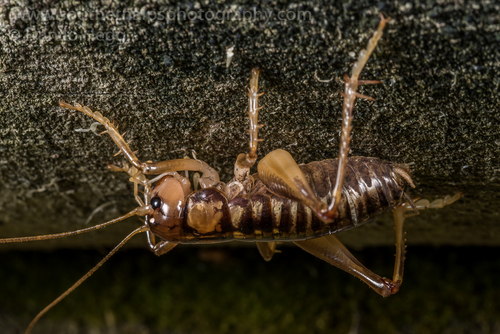
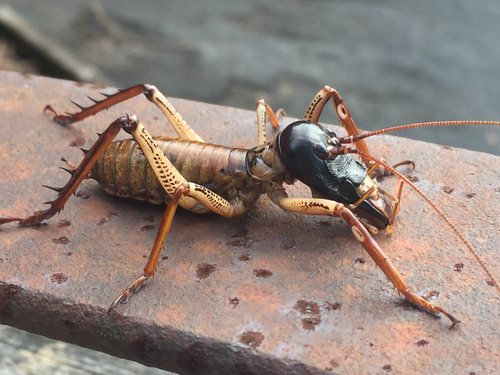
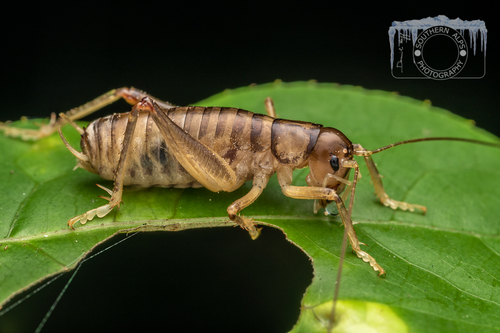
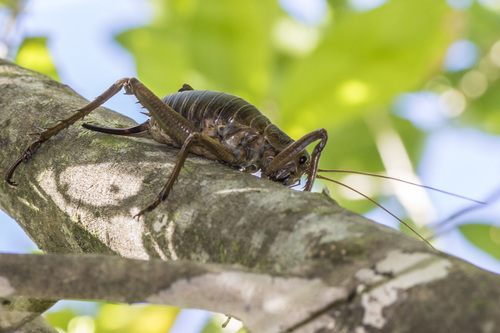
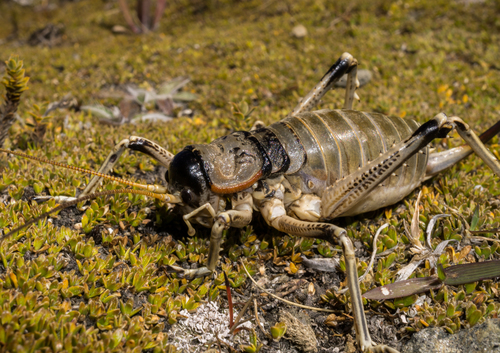
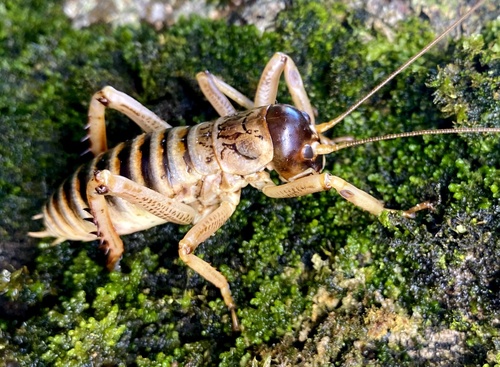
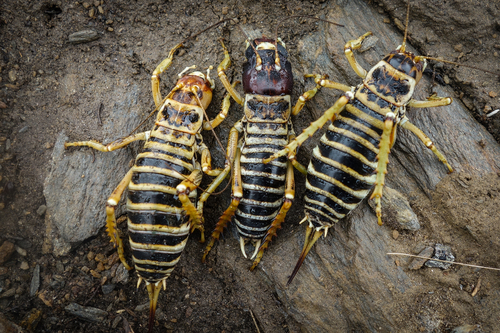
Hemideina maori (Pictet & Saussure, 1893), also called mountain wētā, is a large species of wētā. Adults have an approximate body length of 6 centimeters. There is no difference in mean tibia length between males and females, with both sexes having a mean tibia length of 18.6 +/- 0.17 mm. Both sexes show directional asymmetry in mandible length: the left mandible is longer than the right. Among 48 measured males, the median asymmetry in mandible length is 0.53mm, with a range from 0.01 to 1.37mm. Among 35 measured females, the median asymmetry is 0.49mm, with a range from 0 to 1.21mm. Males can display extreme dimorphism in their weaponry, a trait thought to have evolved from sexual selection for male-male combat to access females. For males and females of similar tibia length, male mandibles tend to be twice as long as female mandibles, and male heads can be up to 1.5 times wider than female heads. Unlike other species in the Hemideina genus, H. maori lives in an alpine habitat. It is found at high elevations above the tree line on the South Island of New Zealand, between 1100 metres and over 1500 metres above sea level. Its range extends from the Kaikōura Ranges south to the Rock and Pillar Range in Otago. During the day, this wētā retreats into cavities under loose rock slabs called tors, which are broken from schist outcrops. Tors are separated by rockless alpine meadows that cannot support wētā, so the species’ populations are fragmented. Mountain wētā do not move far over their lifetime, and are exposed to consistent high winds and low temperatures year-round. Studies of this species’ adaptations to its montane environment found that both cuticular water loss (CWL) and respiratory water loss (RWL) are lower in montane mountain wētā than in lowland wētā. This indicates that montane Hemideina have higher desiccation resistance achieved through reduced water loss. Studies also found that black colour morphs of H. maori lose less total water than yellow colour morphs, a difference driven by lower cuticular water loss in black morphs.