About Hemideina femorata Hutton, 1896
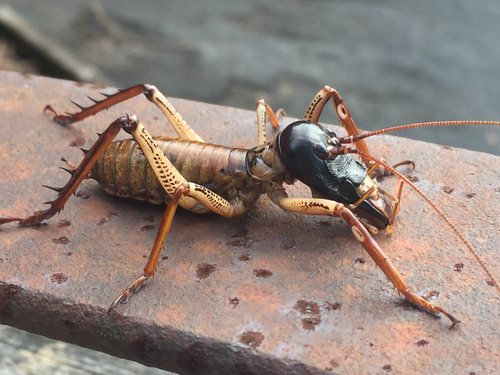
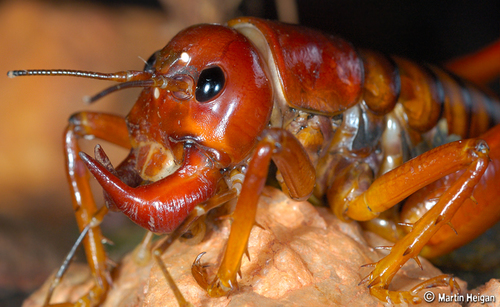
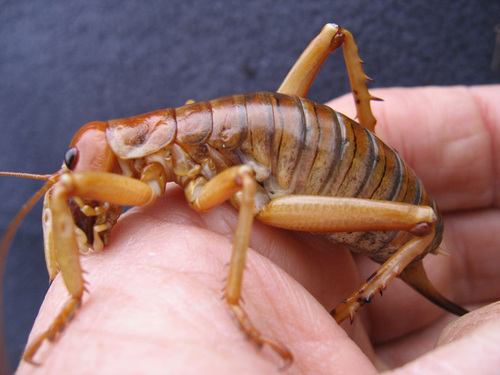
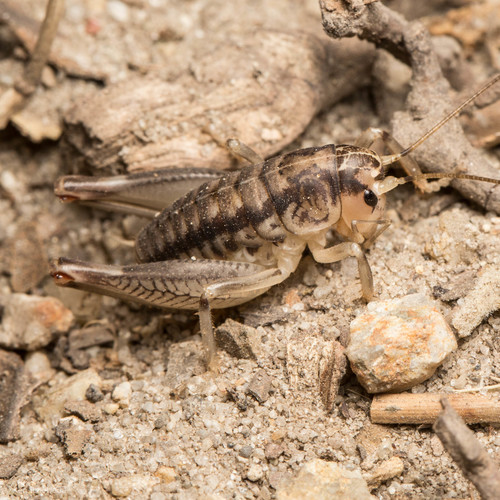
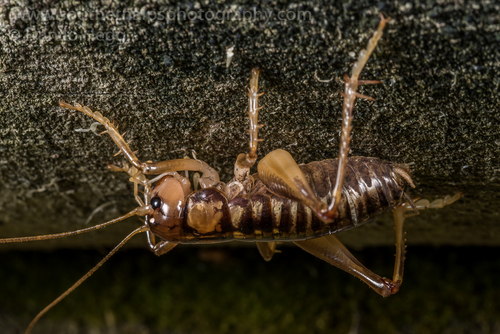
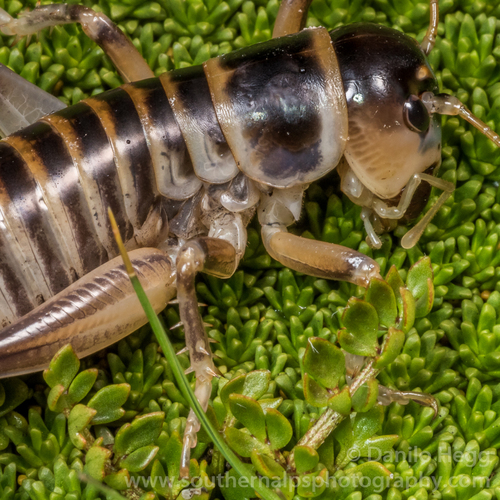
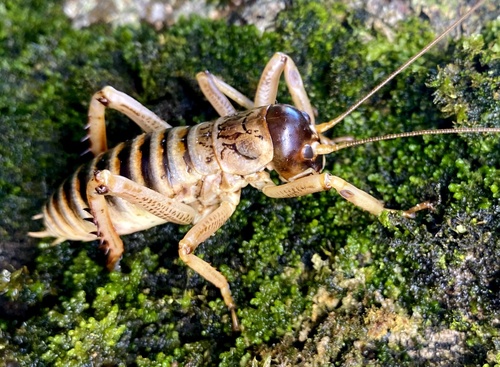
Hemideina femorata Hutton, 1896 (common name Canterbury tree wētā) is a species of large, flightless, nocturnal tree wētā endemic to New Zealand. Like all tree wētā, it has a body divided into three sections: head, thorax, and abdomen. Tree wētā are identifiable by their large hindlegs, strong jaws, glossy hard exoskeleton, and size; male tree wētā also have prominent tusks. Their antennae are typically twice as long as their body, and they use these to feel and navigate safely in the dark. Male tree wētā have larger heads than females, which can account for 40% of their total body length. Females have a long, spike-like ovipositor at the end of their abdomen for laying eggs, while males do not have an ovipositor; males also have a proportionally smaller abdomen than females, with most of their reproductive structures internal, except for two pairs of tiny lobes beneath their paired short tapering sensory cerci at the rear.
Hemideina femorata is distinguished from other tree wētā by its unique color patterning: it has cream-yellow bands that wrap across and around the abdomen, with reddish dark-brown markings on each abdominal segment. It has irregular black markings on the prothorax and hind femora, and some individuals have an extra retrolateral apical spine on the hind femora.
While related to similar-looking cave crickets (camel crickets) found across Australia, Chile, Europe, and Asia, all wētā are native only to New Zealand. Hemideina femorata is restricted to the Canterbury region of New Zealand. Its distribution runs along the east coast from Kaikōura to Geraldine, and extends west as far as Nelson. It is commonly found in kanuka forests near Kaikōura. A 1997 study of populations on Banks Peninsula found that all Hemideina femorata occurred below 450 m altitude, with the majority on north-east facing slopes.
This species inhabits vacated tunnels in tree trunks or branches, originally created by other insects. Tree wētā enlarge and clean these tunnels, which are called galleries. Hemideina femorata occupies a wide variety of host trees, including kanuka (Kunzea ericoides), lacebark (Hoheria angustifolia), mahoe (Melicytus ramiflorus), broadleaf (Griselinia littoralis), tree fuchsia (Fuchsia excorticata), and beech (Fuscospora solandri). 1997 research found this species occurs significantly more often in kanuka than other trees. A 2001 report noted that Hemideina femorata only occupies kanuka growing at or below 320 m altitude, even when kanuka grows at higher elevations. Tree wētā generally prefer to live in groups.
Almost all adult wētā move no more than a few metres from their home gallery; the only exception is females that climb down from trees to lay eggs. Before laying eggs, females need extra protein, so they eat their shed lifetime exoskeletons, and will also eat dead or injured insects, including other wētā.
Courtship in Hemideina femorata is simple, initiated by the male. The male performs antennation (touching with antennae), palpation, and genital probing of the female before attempting copulation. Females lay eggs in autumn (around April or May), when rainfall makes soil softer than it is in summer. The female travels to the ground to test soil suitability with the tip of her ovipositor. When she finds a suitable site, she lifts the end of her abdomen, twists her ovipositor vertically downward, and pushes it as deep as it will go into the soil, reaching a depth of around 15 mm. Females do not lay all their eggs at once; they lay eggs periodically over several weeks, in different locations. A single female can lay up to 200 eggs over two or three months, laying one to six eggs per group. Wētā eggs are about 6 mm long and 1.5 mm thick. They overwinter in the soil, and hatch around October or November. Damp soil during incubation is required for successful hatching. After hatching, the tiny juvenile wētā (called nymphs) emerge from the soil to the surface, and live in tree and shrub foliage for their first few months. Nymphs eat the same diet as adults: mainly leaves, with occasional insect prey when available.
Hemideina femorata has incomplete metamorphosis, growing through a series of juvenile instars before adulthood. One study found that adult sex ratios shift seasonally: from November to January, females outnumber males by less than 15%, then male numbers drop drastically through the year, leaving only females by early March. Before moulting, wētā become inactive for one to two days and turn paler. Most moulting happens at night. Prior to moulting, wētā do not eat or drink for 4 to 14 days and lose weight. To moult, most wētā hang head downward, with their hind legs (and sometimes middle legs) hooked firmly to vegetation. Ecdysis (moulting) begins when the abdomen goes through rhythmic contractions. The thorax and front of the abdomen emerge from the old exoskeleton first, and the antennae are usually the last part to emerge. After moulting, wētā eat their shed old cuticle. Moulting is required because the wētā exoskeleton cannot stretch as the insect grows. Hemideina femorata moults up to six times; overall tree wētā may moult at least 10 times over two years. Males reach adulthood earlier than females, and wait for females to mature before mating. Mating takes place in galleries at night, and can last up to 6 minutes for Hemideina femorata. Females only mate after they reach four times their initial weight, and lay eggs roughly 100 days after courtship. Wētā eggs are laid vertically in soil. Females guard their eggs, and occasionally guard newly hatched first-instar nymphs. Hemideina femorata reaches maturity at two years old, and can live up to 12 years in captivity.