About Hemidactylus platyurus (Schneider, 1797)
Common Name & Patagia Function
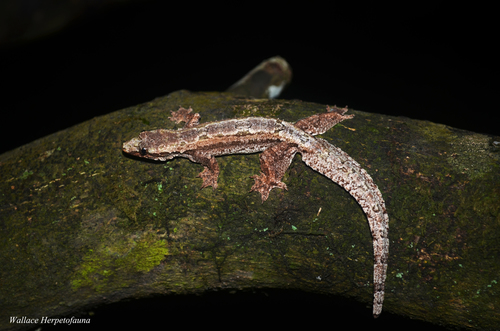
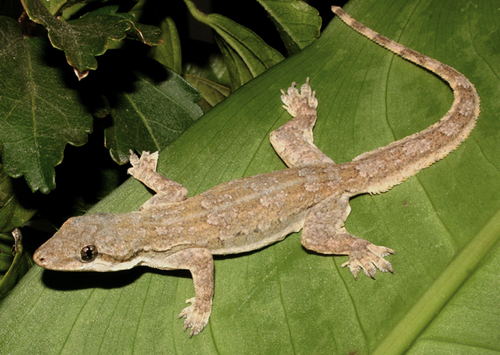
Hemidactylus platyurus, commonly known as the flat-tailed gecko, has patagia (skin flaps) along its trunk, tail, and femoral region that it uses for gliding.
Patagia Structure
Like gliding geckos in the genus Gekko (formerly classified under Ptychozoon), these patagia form from expanded fat deposits along the sides of the body.
Snout Characteristics
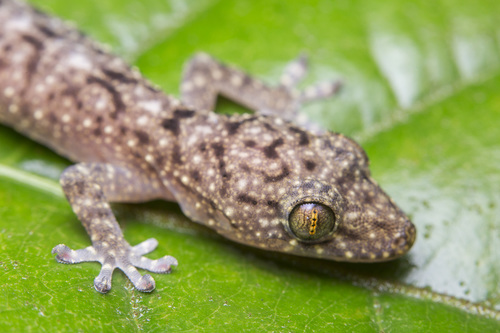
For identification, the snout of this species is longer than the distance between the eye and ear opening, measuring 1.5 times the diameter of the eye orbit.
Forehead & Ear Opening
The forehead is concave, and the ear opening is small, oval, and angled.
Rostral Scale Features
The rostral scale is four-sided, and no more than twice as broad as it is high, with a median cleft along its upper edge.
Nostril Scale Borders
The nostril is bordered by the rostral scale, the first labial scale, and three nasal scales.
Labial Scale Count
There are 9 to 11 upper labials and 7 or 8 lower labials.
Mental Scale Shape
The mental scale is large, and shaped either triangular or pentagonal.
Chin Shield Arrangement
There are two pairs of chin shields: the median pair is large and contacts each other, while the posterior pair is small and sometimes separated from the labials.
Dorsal Body Scaling
The body is depressed, and its dorsal surface is covered in uniform small granules, which are largest on the snout.
Dermal Expansions
There is one dermal expansion running from the axilla to the groin, and a second along the posterior side of the hind limb.
Ventral Scale Traits
Ventral scales are cycloid and imbricate.
Male Femoral Pores
Males have an uninterrupted series of 34 to 36 femoral pores.
Tail Morphology
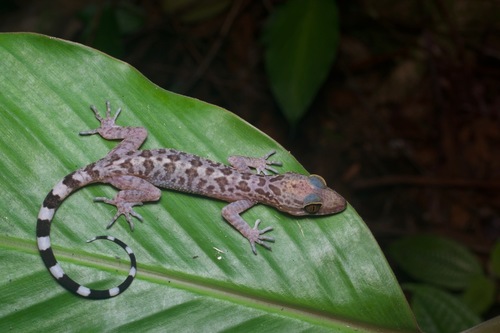
The tail is depressed, flat on its ventral surface, and has a sharp, denticulated lateral edge.
Tail Scaling
The upper surface of the tail is covered in uniform small granules, while the lower surface has a median series of transversely dilated plates.
Limb Structure
Limbs are moderate in size and depressed.
Digit Characteristics
Digits are strongly dilated, about half-webbed, and the inner digits are well developed.
Subdigital Lamellae Count
There are 3 to 6 lamellae under the inner digits, and 7 to 9 lamellae under the median digits.
Dorsal Coloration
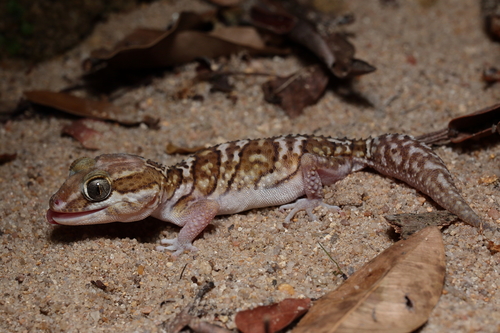
The dorsal body is grey, marbled with darker grey, and usually has a dark streak running from the eye to the shoulder.
Ventral Coloration
The ventral body is white.
Body & Tail Size
The combined length of the head and body is 61 mm (2.4 in), and the tail measures 66 mm (2.6 in).
Native Range
This species is native to Bangladesh, India (including Darjeeling, Sikkim, and the Nicobar Islands), Nepal, Bhutan, China (including Guangdong and southeastern Tibet), Taiwan, Sri Lanka, Thailand, Cambodia, Malaysia (including Tioman), Burma, Vietnam, Indonesia (including Sumatra, Java, Sulawesi, Lombok, Sumbawa, Flores, and Irian), and the Philippines (including Palawan, the Calamian Islands, Panay, and Luzon).
Introduced Range
It has also been introduced to Florida, USA, specifically in Pinellas, Alachua, Lee, Broward, and Miami-Dade counties.