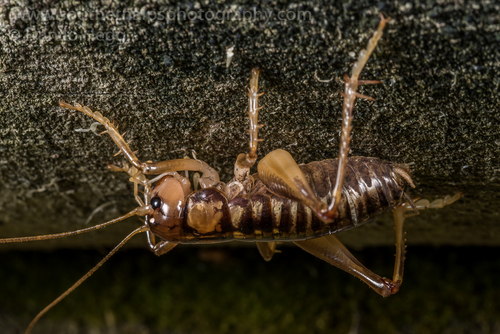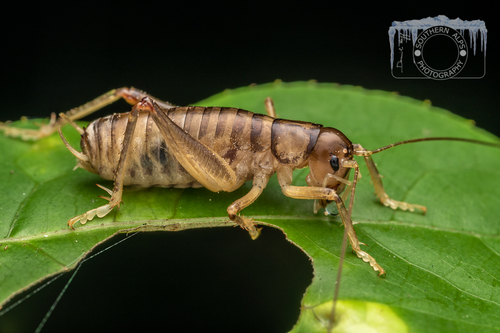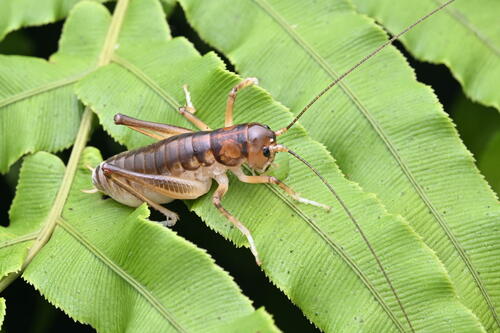
About Hemiandrus pallitarsis (Walker, 1871)
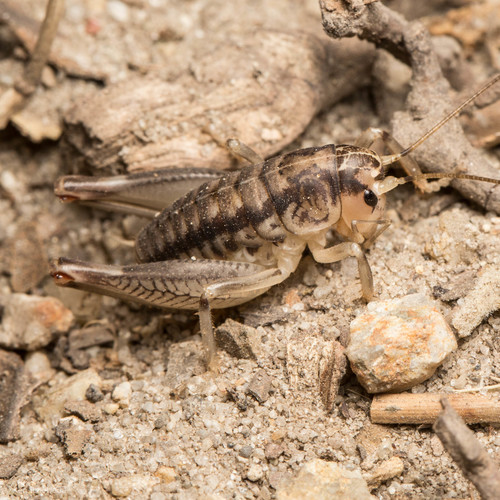
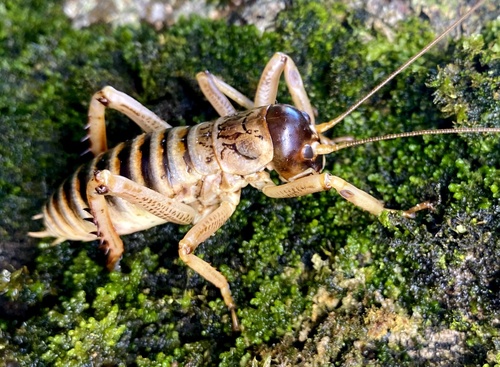
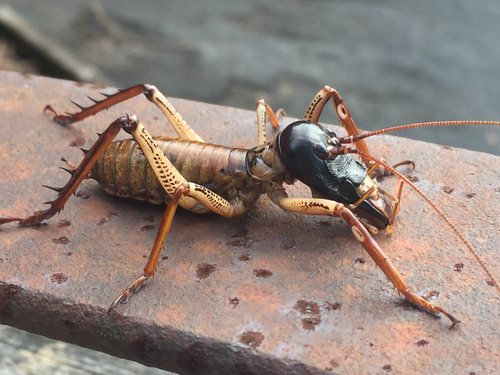
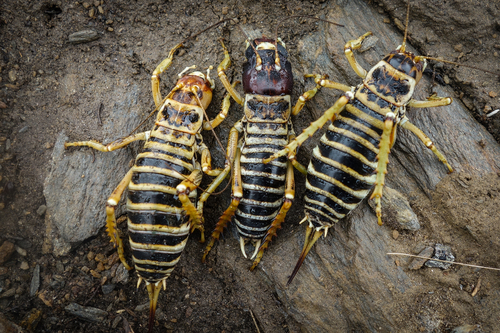
Hemiandrus pallitarsis (Walker, 1871) can be identified morphologically by several key features. It has a single foretibial spine, three prolateral spines, and four retrolateral spines on the mesotibia. Males are identifiable by the blackened hooks on their last tergite. Adult females have an elbow-like, forked enlarged appendage on the abdomen, formed from one of the sternites; Hemiandrus pallitarsis is the only species in the genus Hemiandrus with this type of enlarged appendage. Females are also distinguished by their very short ovipositor, short enough that it is easily overlooked, leading to females being mistaken for males. Species within the genus Hemiandrus have widely varying ovipositor lengths, which can be used to distinguish between different species. This species has no tympanum, and instead detects sound through its cuticle, an adaptation to its underground lifestyle. The tibiae lack tympanal membranes, and also lack vestiges of the structures found on the legs of other Orthoptera. Hemiandrus pallitarsis is endemic to the North Island of New Zealand. It is widespread across this range and is relatively abundant. As a nocturnal species, it typically stays in underground burrows during the day. At night, it is active on the ground, and can also be found in vegetation including beech trees, kanuka bushes, and the leaves of plants such as kawakawa. This species is most often found at elevations below 200 metres.