About Hemaris thysbe Fabricius, 1775
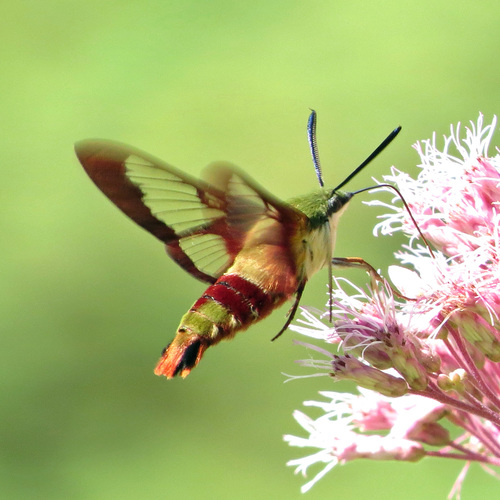
Adult Hemaris thysbe moths have spindle-shaped bodies, mostly covered by a thick layer of fur. There is noticeable variation in coloration between individual moths. Typically, the dorsal side of the moth has an olive to golden-olive thorax, and a burgundy to black abdomen marked with light olive to dark golden patches. On the ventral side, the thorax ranges from white to yellow, and the abdomen is burgundy to black. When H. thysbe first emerges, its wings are dark red to black. As the moth starts flying, scales fall off the wings, leaving mostly clear wings with reddish-brown borders and veins. The width, shape of the border, and vein patterning all vary between individuals. This moth beats its wings very rapidly, and has a wingspan of 4 to 5.5 centimetres (1.6 to 2.2 in). H. thysbe has light-colored legs, most often yellow. In general, southern broods and individuals that hatch later in the season are darker in color. Southern and eastern populations typically have jagged wing borders, while northern and western populations usually have smooth wing borders. The antennae of H. thysbe are thicker at their base and curved at the tips. Unlike most moth species, H. thysbe has no hearing organs. It has compound eyes and well-developed reproductive organs. H. thysbe can be told apart from the related species Hemaris gracilis and Hemaris diffinis by its lack of stripes on the underside of the thorax, and by its pale legs. In comparison, H. gracilis has reddish legs and H. diffinis has black legs. H. thysbe caterpillars are yellowish green, with dark green and reddish brown to dark brown bands. Their bodies have a granular texture covered in small white spots, and a white horn projects from their posterior end. As caterpillars, H. thysbe feed on cherry trees, European cranberry bush, hawthorns, dogbane, honeysuckle, and snowberry. Caterpillars burrow into soil to overwinter as brown, hard-shelled pupae, and emerge as adult moths in late spring. H. thysbe lays green eggs on the underside of plant leaves, which hatch in approximately one week. Caterpillar development takes four weeks, after which the caterpillar spins a cocoon at ground level. In southern climates, two to four weeks after pupation an adult moth emerges for a second breeding cycle before the end of summer. In northern climates, H. thysbe only has one mating cycle per year. The mating and other behavioral habits of H. thysbe have not been well researched. Adult moths are most active during the hottest parts of the day, and remain active until sunset. H. thysbe uses a long 19–21 millimetres (0.75–0.83 in) proboscis to collect nectar from a wide range of flowers while hovering above the blooms. It prefers pink and purple flowers, and moves quickly from one flower to the next. This moth is considered a hummingbird mimic, and is often mistaken for a hummingbird or a bumblebee. H. thysbe inhabits second-growth forests and meadows, and is commonly found in suburban cultivated gardens. It is a migratory species capable of traveling long distances. In regions with only one brood per year, adults can be found throughout the summer. In the southern part of its range, adults are present from March to June and from August to October. H. thysbe is most abundant in the eastern United States and southern Ontario. Its range extends east to Newfoundland, and west to Texas, the Great Plains, and into Manitoba, Saskatchewan and Alberta. On the west coast of North America, its range stretches from Oregon north to the Yukon Territory and Alaska. It has minimal economic impact on humans, as it is neither a crop pollinator nor a pest. However, the moth does pollinate several types of cultivated flowers, and is the primary pollinator for some orchid species. H. thysbe is not an endangered or threatened species.