About Hemachatus haemachatus Bonnaterre, 1790
Colouration Variability
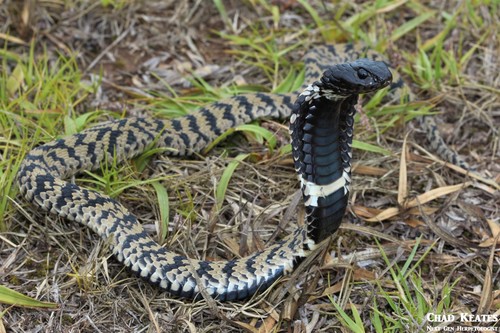
The colouration of the rinkhals (Hemachatus haemachatus) varies across its distribution range.
Consistent Belly Markings
A consistent species characteristic is a dark belly marked with one or two light-coloured crossbands on the throat.
Size Range
Most individuals reach a total length of 90–110 cm (35–43 in) including the tail.
Body Pattern Morphs
Some rinkhals have an almost entirely black body, while others display striped patterning.
Dorsal Scale Trait
Its dorsal scales are keeled, which distinguishes them from the dorsal scales of cobras in the genus Naja.
Dental Trait Difference From Naja
Like many other traits, the rinkhals also differs from Naja cobras in that it lacks solid teeth on the maxilla.
Core Distribution Range
This species is distributed from the Western and Eastern Cape provinces of South Africa, northeastward through the Free State, Lesotho, KwaZulu-Natal (South Africa), Western Eswatini, Mpumalanga, and parts of Gauteng (South Africa).
Isolated Border Population
There is an isolated population centered on Inyanga at the Zimbabwe-Mozambique border.
Isolated Population Status
No recent records exist for this isolated population, so researchers suspect it is likely extinct.
Preferred Habitat Type
Rinkhals generally prefer grassland habitats, which occur from the coast up to altitudes of 2,000 m (6,600 ft).
Regional Habitat Abundance
They are extremely common on the Highveld and in the grasslands of KwaZulu-Natal.
Wetland Habitat Association
Because the species naturally preys on frogs and toads, it is also frequently found near wetlands within its range.
Reproductive Mode
Unlike Naja cobras, the rinkhals is ovoviviparous: it does not lay eggs, and instead gives birth to live young.
Litter Size Range
Typical litters contain 20 to 30 live young, though some females can produce litters of over 60 live young.
Birthing Period
Rinkhals typically give birth in late summer, which falls between December and March in the southern hemisphere.