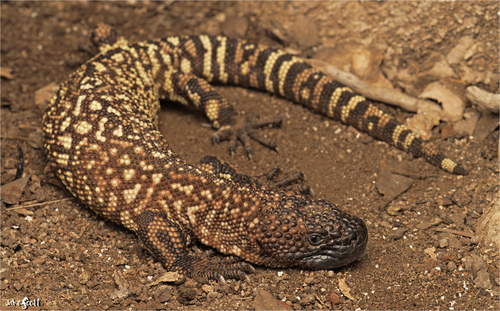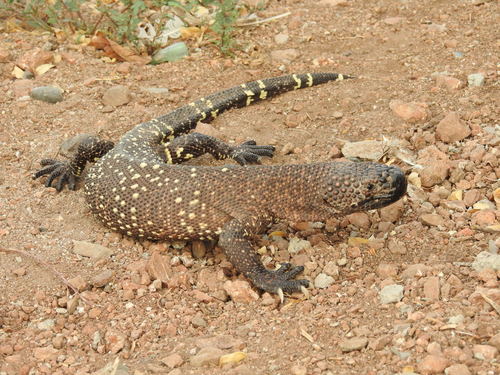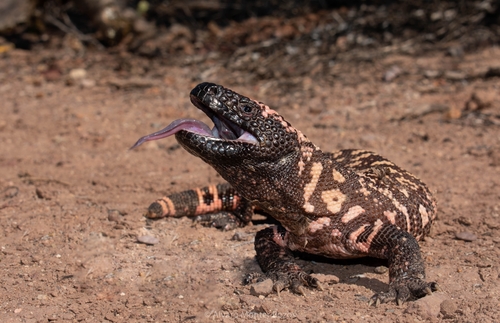
About Heloderma suspectum Cope, 1869
Taxonomy and Nomenclature
The Gila monster, with the scientific name Heloderma suspectum Cope, 1869, is a venomous lizard species native to the Southwestern United States and the northwestern Mexican state of Sonora.
Physical Description and Status
It is a heavy, slow-moving reptile that grows up to 56 cm (22 in) long, and it is the only venomous lizard native to the United States.
Related Species
Its close venomous relatives, the four beaded lizards (all formerly classified as subspecies of Heloderma horridum), live in Mexico and Guatemala.
Human Threat Risk
Gila monsters are naturally sluggish, so they are not generally dangerous and very rarely pose a real threat to humans.
Legal Protection
Even so, they have a fearsome reputation and are sometimes killed, despite being protected by Arizona state law.
Geographic Range
The Gila monster's range covers the Southwestern United States and Mexico, including Sonora, Arizona, and parts of California, Nevada, Utah, and New Mexico, with no confirmed records of the species from Baja California.
Habitat Types
They live in scrubland, succulent desert, and oak woodland, and seek shelter in burrows, thickets, and under rocks in locations with a favorable microclimate and adequate humidity.
Shelter Characteristics
Gila monsters rely heavily on shelters and spend most of their time there; these shelters are often found in rocky areas of Navajo Sandstone and basaltic lava flows.
Water Dependence
The species depends on water resources, and can be spotted in rain puddles after summer rain.
Avoided Habitats
They avoid open areas such as flats and open grasslands.
Shelter Use Duration
Gila monsters spend 90% of their lives underground in burrows or rocky shelters.
Spring and Early Summer Activity
They are active in the morning during the dry spring and early summer season, and move to a new shelter every 4–5 days until the start of summer, to find a suitable microhabitat.
Late Summer Activity
Later in summer, they may be active on warm nights or after thunderstorms.
Baseline Body Temperature
They maintain a surface body temperature of around 30 °C (86 °F).
Thermoregulation Mechanism
When temperatures near 37 °C (99 °F), they can lower their body temperature by up to 2 °C (3.6 °F) via limited activated evaporation through the cloaca.
Utah Population Activity Peak
A study of a Gila monster population in southwestern Utah found that the species' activity peaks from late April to mid-June.
Movement Distance
The average distance Gila monsters travel during active periods is 210 metres (690 ft), though some individuals occasionally travel more than 1 kilometre (0.62 mi).
Active Season Duration
Across their roughly 90-day active season, Gila monsters only spend 10 days active.
Locomotor Physiology
They are slow sprinters, but have relatively high endurance and maximal aerobic capacity (VO2 max) compared to other lizards.
Predators
Their predators include coyotes, badgers, and raptors, while hatchlings are preyed on by snakes such as kingsnakes (Lampropeltis sp.).
Metabolic Adaptation
Adaptations to their dry environment include a slow metabolism, which lets them use less than half the energy expected for a lizard of their size.
Water Storage Adaptation
Gila monsters (and possibly Mexican beaded lizards) store water in their urinary bladder and reabsorb it through the bladder epithelium.
Fat Storage Adaptation
Their tails store fat as an energy reserve.
Brumation Emergence
Gila monsters emerge from brumation in early March.
Sexual Maturity and Mating Period
They reach sexual maturity at 4–5 years old, and mate in April and May.
Male Courtship Behavior
Males initiate courtship by flicking their tongue to track a female's scent; if the female rejects his advances, she will bite him and chase him away.
Copulation Characteristics
When mating is successful, copulation has been observed to last between 15 minutes and two and a half hours in captivity, and there is only one recorded instance of attempted mating outside of a shelter.
Egg Laying
Females lay eggs from late May into June, with clutches containing up to eight eggs, though rarely more than six.
Captive Incubation Period
In captivity, eggs incubate for around 5 months, depending on incubation temperature.
Hatchling Characteristics
Hatchlings measure around 16 cm (6.3 in) long, and can bite and inject venom immediately after hatching.
Historical Hatching Timing Speculation
The timing of egg development and hatching in wild Gila monsters was the subject of speculation for decades.
Hatching Hypotheses
The first model proposed that young hatch in fall and stay underground, while the second theory suggested that nearly fully developed embryos remain inside eggs over winter and hatch in spring.
Hatchling Surface Observation Timing
Hatchlings, which weigh around 35 g (1.2 oz), are observed on the surface from late April to early June.
Hatching Observation Event
This debate was unexpectedly resolved on October 28, 2016, when a backhoe digging at the outer walls of a house in a northern Tucson suburb uncovered a Gila monster nest with five eggs that were in the process of hatching.
Confirmed Hatching Timeline
It is now confirmed that Gila monsters hatch near the end of October, immediately enter brumation without surfacing, and emerge on the surface from May to June the following year, when prey is abundant.
Summer Activity Pattern
In summer, Gila monsters gradually spend less time on the surface to avoid the hottest part of the season, and may occasionally be active at night.
Post-Laying Female Condition
Females that have laid eggs are left exhausted and thin, and must put in extra effort to recover their condition.
Brumation and Lifespan
Gila monsters enter brumation in October, and can live up to 40 years in captivity.
Male-Male Combat Behavior
Little is known about the social behavior of Gila monsters, but male-male combat has been observed: the dominant male lies on top of the subordinate male and pins it with its front and hind limbs.
Combat Mechanics
Both lizards arch their bodies, push against each other and twist to gain the dominant position.
Combat Outcome
Wrestling bouts end when one exerts enough pressure to overpower the other, and bouts may be repeated.
Combat Reproductive Role
These combats typically occur during the mating season, and males with greater strength and endurance are thought to have higher reproductive success.
Aerobic Capacity Adaptation
While Gila monsters have a low metabolism and one of the lowest sprint speeds among lizards, they also have one of the highest aerobic scope values (the increase in oxygen consumption from rest to maximum metabolic exertion) among lizards, letting them engage in intense aerobic activity for extended periods.
Venom Fatality Risk for Adults
Gila monster venom is normally not fatal to healthy adult humans.
Recorded Fatalities
Only one fatality has been confirmed since 1930, which occurred on February 16, 2024; rare fatalities recorded before 1930 involved adults who were intoxicated or had mismanaged bite treatment.
Bite Release Methods
Gila monsters can bite quickly, and may not release a victim without intervention. If bitten, a victim may attempt to fully submerge the lizard in water, pry its jaws open with a knife or stick, or yank the lizard free.
Bite Risk From Pulling
Pulling the lizard directly increases the risk of severe lacerations from its sharp teeth.
Bite Symptoms
Symptoms of a bite include extreme pain, edema, weakness, and a rapid drop in blood pressure.
Bite Pain Account
YouTuber Coyote Peterson described the bite as "like hot lava coursing through your veins" and stated it was the worst pain he had ever experienced.
Venom Pain Ranking
Gila monster venom is generally regarded as the most painful venom produced by any vertebrate.
Isolated Venom Compounds
More than a dozen peptides and other compounds have been isolated from Gila monster venom, including hyaluronidase, serotonin, phospholipase A2, and several kallikrein-like glycoproteins that cause the pain and edema of a bite, without triggering compartment syndrome.
Lethal Venom Toxins
Four potentially lethal toxins have been isolated from the venom: these cause internal organ hemorrhage and exophthalmos (bulging of the eyes), and helothermine, which causes lethargy, partial limb paralysis, and hypothermia in rats.
VIP-like Venom Components
Some venom components have an action similar to vasoactive intestinal peptide (VIP), which relaxes smooth muscle and regulates water and electrolyte secretion between the small and large intestines. These bioactive peptides can bind to VIP receptors in many different human tissues.
Medicinal Venom Component
One component, helodermin, has been shown to inhibit the growth of lung cancer cells in vitro.
2024 Fatal Bite Incident
In February 2024, a man from Colorado died after being bitten by a pet Gila monster for four minutes, and an autopsy determined the cause of death was the bite and resulting venom exposure.