About Helmitheros vermivorum (J.F.Gmelin, 1789)
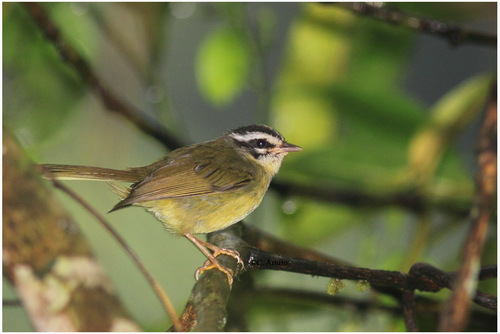
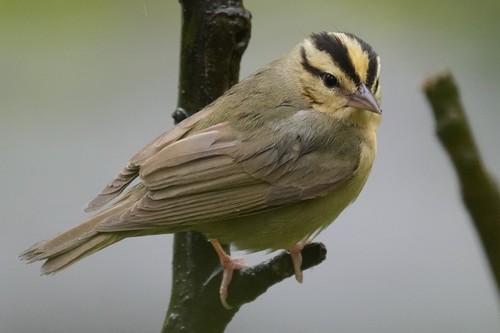
The worm-eating warbler (Helmitheros vermivorum) is a small New World warbler. It measures around 13 cm (5.1 in) in length and weighs between 11.8–17.4 g (0.42–0.61 oz). Its plumage is relatively plain: it has olive-brown upperparts, light-coloured underparts, and distinct black and light brown stripes on its head. It has a slim pointed bill and pink legs. The head stripes of immature birds are brownish. Males produce a short, high-pitched trill as a song, while the species' typical call is a chip or tseet. Worm-eating warblers are sexually monomorphic, meaning males and females look identical; the only reliable way to distinguish sexes during the breeding season is to check for a brood patch in females or a cloacal protuberance in males. Aging these birds is also difficult. Hatch year/second year birds have rusty tips on their tertials that wear away by March of the following year. Juveniles can be identified by their duskier head markings and cinnamon wingbars. Worm-eating warblers breed in the Eastern United States, and their habitat selection varies substantially between different populations. Across most of their range, they are associated with mature hardwood forests growing on steep slopes. However, little research has been done on the ecology and conservation status of recently studied coastal breeding populations. Historically, coastal populations occupied pocosin ecosystems, but more recently these populations have shifted to frequently using pine plantations. Current pine plantation habitats support higher population densities than areas historically considered the species' natural habitat. This shift in habitat selection suggests that worm-eating warblers are more closely associated with shrub structure than with forest stand age or size. If this is correct, landscape changes on the Atlantic coastal plain have likely had less negative impact on these birds than previously assumed. Maintaining suitable habitat for this species may require management that supports dense shrubby midstory and understory. Because this species relies on shrub structure for foraging and nests on the ground, frequent fires have a negative impact on the species. Other management practices that reduce shrub midstory, increase herbaceous growth, and decrease canopy cover are likely to have a similar negative effect. More research is needed on the breeding habits of coastal populations, as these coastal forests present different conditions than the species' inland breeding habitats. For most long-distance migratory passerines, fat deposits are critical to completing migration, and stopover habitats that allow birds to replenish fat stores are also essential. In winter, worm-eating warblers migrate to southern Mexico, the Greater Antilles, and Central America, particularly along the Caribbean Slope, where they occupy both scrub and moist forests. Worm-eating warblers have been extirpated from some parts of their original range due to habitat loss, but their ability to use both scrub and moist forest ecosystems may benefit the species' long-term conservation. The diet of worm-eating warblers differs across habitat types, a variation that is tied to different predator avoidance strategies used by the species' common prey. On breeding grounds, worm-eating warblers mostly glean prey from live foliage while searching for arthropods. On wintering grounds, the species almost exclusively gleans insects from dead plant material. Despite its common name, the worm-eating warbler rarely, if ever, eats earthworms; the name actually refers to the many Lepidopteran larvae (caterpillars) that the species consumes. Widespread broadcast application of pesticides is likely to impact most insectivorous songbird species including the worm-eating warbler. These pesticides reduce the species' primary food source and could cause long-term toxicity.