About Helminthotheca echioides (L) Holub
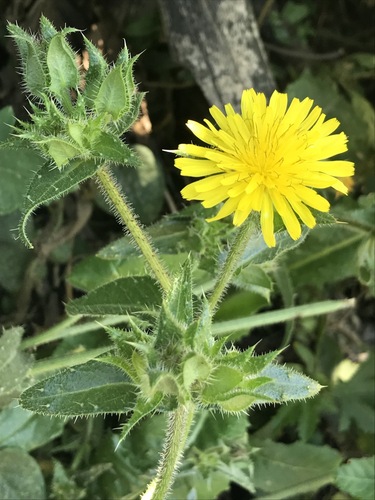
Helminthotheca echioides, commonly known as bristly oxtongue, is an annual to biennial herb that grows with an erect or sprawling habit. It typically reaches up to 90 cm (35 in) tall, and may grow up to 150 cm in fertile soils and shady locations. It has a solid, furrowed stem with spreading branches. Its basal rosette leaves are 10–20 cm (4–8 in) long, oblanceolate with a short petiole, while cauline leaves are lanceolate and sessile with clasping, cordate bases. The leaves and stem, especially the basal leaves, have distinctive 2 mm long sharp bristles with swollen whitish blister-like bases. Other parts of the plant are scattered with smaller, anchor-shaped hairs with recurved double-pronged tips that give the plant a sticky feel. In northern Europe, this species flowers from May to October. Inflorescences grow on long stalks from leaf axils, forming an irregular corymb. Each flowerhead is 2–3.5 cm (0.8–1.4 in) wide, with numerous yellow ray flowers, and the outer florets are sometimes tinged red or brown. Flowerheads are surrounded by three rows of involucral bracts. The inner ring is narrow and blunt-tipped, with a spiny awn growing just below the tip. A middle ring of tiny bracts sits at the base of the inner row, and is easily overlooked; these bracts are important for distinguishing this species from other members of the genus Helminthotheca. The outer ring consists of 3 to 5 large, ovate-cordate flaps that later surround the seed head; this outer ring of bracts is the defining feature of the genus Helminthotheca. Helminthotheca echioides is reported to be heterocarpic, meaning it produces two different shapes of fruit, though not all authors record this trait. When heterocarpy is present, outer achenes, which are retained in the closed seedhead after central achenes disperse, are slightly longer at 7 mm and curved, while inner achenes are only 5 mm long and straight. Typical achenes range in color from yellow to orange or brown, have transverse scaly ridges, and a narrowed beak about as long as the achene body. A pappus of two rows of white, feathery plumes attaches to the beak, allowing seeds to disperse via wind. Reproduction is thought to be apomictic, meaning plants effectively clone themselves, though bees also visit the species' flowers. Helminthotheca echioides is believed to be native to North Africa and the Mediterranean Basin, where it grows in semi-arid conditions, and now colonizes ruderal agricultural habitats and human-created disturbed soils across the world. It has spread as a weed to all continents except mainland Antarctica, and is often abundant in farmland and urban areas. The IUCN has not yet assessed the species' global conservation status, but within its native range, assessed populations are generally classified as LC (least concern). In Great Britain, it is common in the south and east, more patchily distributed in the north and west, and rare in Ireland. It is considered an archaeophyte (ancient introduction) across the British Isles, and is thought to be increasing in many areas. It has been introduced to North America, where it occurs from Nova Scotia to British Columbia and California, and is classified as an invasive weed. It was first recorded in Australia in 1871, and has since spread to most parts of the country. Bristly oxtongue is an opportunistic species that colonizes disturbed ground very quickly. It can act as a therophyte, which completes its life cycle quickly, or a hemicryptophyte, which maintains a basal rosette to survive unfavorable conditions like winter or drought. Its feathery pappus allows wide wind dispersal of seeds, but it cannot spread vegetatively via structures like stolons or bulbs. Typical habitats include waste ground, field margins, sea walls, road verges, and banks on clay or chalk soils. One factor behind its success is high drought resistance: it can sprout from basal shoots after dry periods. It generally grows in full sunlight, but tolerates partial shade such as that found along hedgerows. It requires moderately damp, slightly alkaline soils, and prefers moderately fertile conditions. Its Ellenberg values in Britain are L = 7, F = 5, R = 7, N = 6, and S = 0. In the British Isles, it is a lowland plant, recorded only up to 370 m in south Wales. The UK Database of Insects and their Food Plants lists four insect species that use bristly oxtongue. Larvae of the widespread European and Asian fly Tephritis separata live on the plant's flowers. Larvae of the wasp Phanacis caulicola tunnel chambers inside the plant's stem, leaving no visible sign of their presence until they emerge. Two moth species also use this plant: Neocochylis hybridella caterpillars feed within the seedheads, and Tortrix moth Aethes tesserana larvae feed within the roots; both moth species are widespread in Europe and western Asia. Historically, the leaves of bristly oxtongue were used as a pot herb, and were esteemed good to relax the bowels. There are also multiple reports of it being used as an antihelminthic treatment, though this use may stem from confusion about the meaning of the species' name. English herbalist Nicholas Culpeper considered "Lang de Boeuf" (bristly oxtongue), when steeped in wine, a good cure for melancholy and a general alexipharmic (antidote to unspecified toxins). It is not a popular culinary herb, but some foragers use its flowers to flavor vinegar. Some pet owners feed the leaves to their tortoises, though many tortoises apparently do not like it.