About Helleborus niger L.
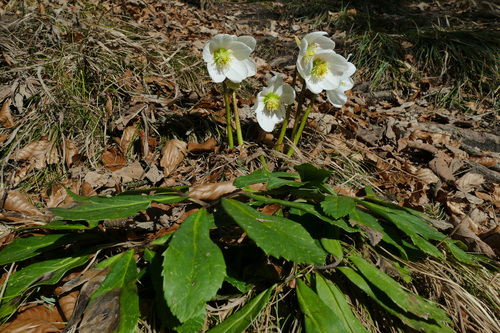
Helleborus niger L. is an evergreen plant with dark, leathery pedate leaves that grow on stems 9 to 12 inches (23 to 30 cm) tall. Its large flat flowers, produced on short stems from midwinter to early spring, are usually white, though they sometimes carry a pink tinge. The tips of the petals may have a pink or green flush, and the flower has a prominent central yellow cluster.
The natural range of Helleborus niger extends from the eastern Northern Alps (including the Julian Alps and Triglav) and the Southern Alps, west to Vorarlberg. It is also common in the Apennines and the Northern Dinaric Alps of Slovenia and Croatia. It has been recorded growing at elevations up to 1900 meters, and up to 1560 meters in the Berchtesgaden Alps. Within Germany, Helleborus niger is native only to Bavaria, and is not indigenous to the Allgäu Alps.
All parts of the Helleborus niger (common name Christmas rose) plant are considered toxic if consumed, or if there is physical contact with sap from damaged plant tissues. This toxicity comes from varying levels of different glycosides in the plant's organs, which are common plant defenses against herbivores and microorganisms.
Helleborus niger is commonly called the Christmas rose because of an old legend that it sprouted in the snow from the tears of a young girl who had no gift to give to the Christ child in Bethlehem. Another legend says the flower blooms at the English abbey founded by St. Thomas, and is said to bloom around the new calendar date of 6 January, which was Christmas Day under the old Julian calendar. The legend holds that when Christmas Day under the new calendar arrived and the flower did not bloom, this was such a frightening omen that England did not adopt the Gregorian calendar in 1588, delaying adoption until 1751.
In the Middle Ages, people scattered the flowers on their home floors to drive out evil influences. They blessed their animals with the plant and used it to protect against the power of witches. At the same time, people believed that witches used this herb in their spells, and that sorcerers threw the powdered herb into the air around them to make themselves invisible.
In early medical practice, two types of hellebore were recognized: black hellebore, which included various Helleborus species, and white hellebore, now classified as Veratrum album (or "false hellebore"), which belongs to the different plant family Melanthiaceae. Black hellebore was used by ancient peoples to treat insanity, melancholy, gout and epilepsy. It is also toxic, causing tinnitus, vertigo, stupor, thirst, a feeling of suffocation, swelling of the tongue and throat, emesis, catharsis, bradycardia (slowed pulse), and eventually collapse and death from cardiac arrest. However, research conducted in the 1970s found that the roots of H. niger do not contain the cardiotoxic compounds helleborin, hellebrin, and helleborein that give black hellebore its lethal reputation. It appears that earlier studies may have used commercial preparations made from a mixture of material from other species, such as Helleborus viridis (green hellebore). In antiquity, the most famous source of black hellebore was the Phokian city of Antikyra in Greece. Black hellebore was the primary purgative of antiquity, frequently prescribed for that purpose by Hippocrates, the father of medicine, in the fifth century B.C. It is said to have been introduced by Melampus, who used it to heal the madness of the daughters of Proteus, king of Argos. Approximately one hundred years later, Theophrastus noted the sedative property of hellebore.