About Heliothis punctifera Walker, 1857
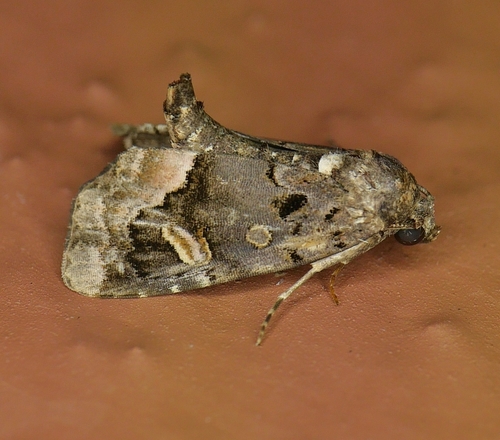
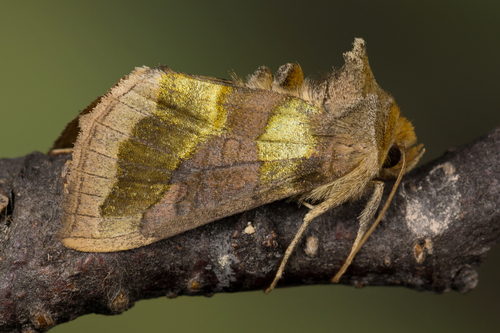
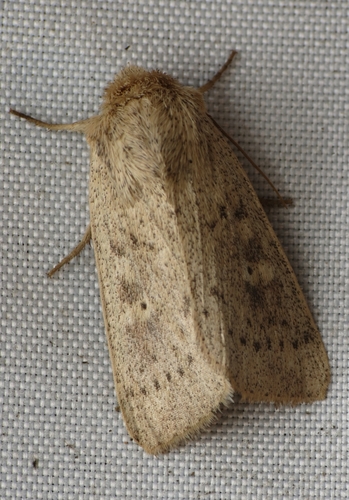
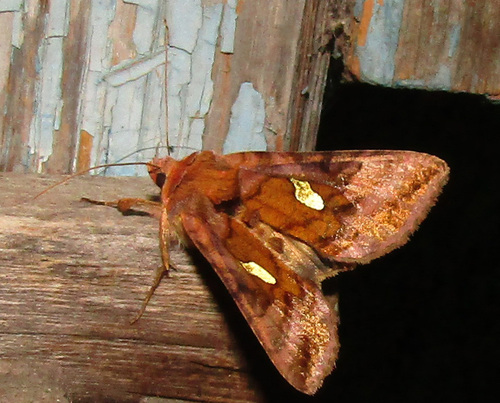
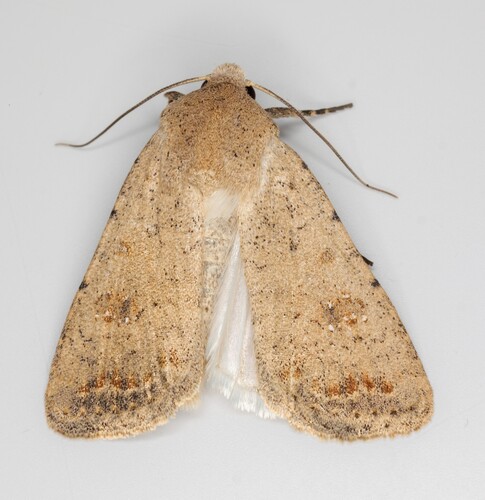
The caterpillar of the lesser budworm (Heliothis punctifera) has lengthwise dark green to light brown stripes separated by thin white lines, plus a thick pale stripe along each side of its body. Its most distinctive feature compared to similar species is the light-colored hairs found behind its head. Adult lesser budworm moths have a clear, bold pattern on their brown to orange forewings. Their hindwings are dark, fading to a lighter color at the base. Each forewing has a large dark comma-shaped marking on its underside, and adult moths have a wingspan of approximately 30 mm. As a species of noctuid moth, lesser budworm moths travel at night at high altitudes, and are capable of flying hundreds of kilometers. Because this moth occurs mainly in arid inland areas, generally far from agricultural regions, far less monitoring data exists on its migrations than for better-known pest heliothine moth species. Lesser budworm caterpillars are extremely mobile, moving across desert sand between host plants to consume many flower heads to support their development. Most of the desert plants that make up their diet bloom in winter, as part of a seasonal growth event that follows rain in inland regions. Heliothis punctifera is primarily found in arid inland desert regions, but it is not restricted to this habitat and occurs across all Australian states. The adult lifespan of a heliothine moth is around 10 days. During this time, female moths can lay a large number of eggs on host plants, up to 1000 total. Successful breeding of the lesser budworm and other heliothine moths depends on significant rainfall in late autumn and early winter, which stimulates the growth of desert flowers. Rainfall variability across arid inland Australia means some host plant growth occurs scattered across the country, but both the amount of growth and its location change from year to year. Heliothine moth eggs generally hatch within 3 to 10 days, with hatching time depending on environmental temperature. If temperatures are too low for metamorphosis, eggs and pupae can enter a diapause phase to overwinter. By late winter and early spring, incoming warmer, drier weather usually triggers the senescence of the season's generation, and leads to an emergence of adult lesser budworm moths. Favorable wind patterns and warm nights support their longer-distance migration.