About Heliornis fulica (Boddaert, 1783)
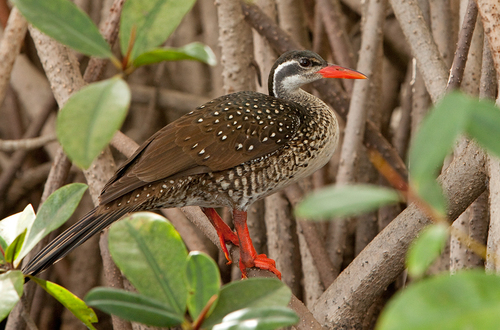
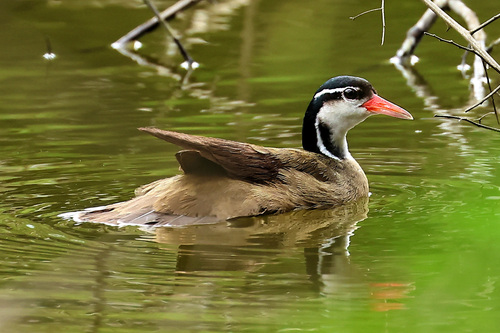
This species, Heliornis fulica, commonly called the sungrebe, has distinct physical markings. When perching or on land, sungrebes display boldly banded yellow-and-black legs and lobed feet. Most of their body plumage comes in varying shades of reddish brown. Their head and neck have a striking pattern: a black crown and nape, white stripes along the neck sides, and white throat and chin. The long tail makes up almost a third of the bird's total length; it extends well beyond the body during flight, and sits fanned out on or just below the water surface when the bird swims.
Sungrebes are sexually dimorphic. Females are more brightly colored, and on average slightly smaller but more powerfully built than males. Females have a rufous patch on the side of the face that brightens to cinnamon-orange during the breeding season. In breeding season, a female's eye ring also becomes brighter, and her lower mandible changes from dark red to bright scarlet. Average female measurements are: body length 27 cm (11 in), wing length 13.77 cm (5.42 in), and body mass 130–140 g (4.6–4.9 oz).
Males are similar to females, but have slightly drabber plumage. In particular, males lack the bright eye ring and orange-rufous cheek patches that females have. While a male's lower mandible changes from pale beige to dark red during breeding season, it never becomes as bright as a female's. Average male measurements are: body length 30 cm (12 in), wing length 14.1 cm (5.6 in), and body mass 110–140 g.
Juveniles have plumage similar to males, but are slightly smaller, with a grayer cast to their body feathers and more white on the cheeks and neck. After chicks leave their father's pouch and become independent, they are covered in fuzzy down that is countershaded slate-gray, with a white belly and throat. Their bill is slate-gray with a pale yellow tip.
Sungrebes inhabit heavily vegetated, mostly freshwater wetland environments. Their range extends from northeast Mexico south along the Gulf and Caribbean coasts through Panama, where they live throughout the Canal Zone and Darien, then continues along the Pacific coast from Panama through central Ecuador. They are also found across the Orinoco and Amazon Watershed, the Pantanal, and the Brazilian Atlantic Rainforests. Apart from Trinidad and Tobago, they do not occur in the insular Caribbean, and appear to have difficulty dispersing across long stretches of saltwater. Though occasionally recorded at higher elevations, sungrebes are usually associated with lowland areas from sea level up to around 500 meters. They are resident birds across their entire range and do not migrate.
The northern limit of the sungrebe's range is currently expanding in northeastern Mexico. Historically, they occurred no farther north than central Veracruz, but by the 1940s they had established populations across all of Veracruz and into San Luis Potosí. They are now expanding further north into Tamaulipas, and one individual was sighted on 13 November 2008 on the Marsh Loop at Bosque del Apache National Wildlife Refuge in New Mexico, USA, which is the first recorded occurrence of sungrebes in the United States.
Sungrebes prefer quiet forest streams and rivers, freshwater ponds, and lakes with thick, overhanging vegetation. In these habitats, they hunt snails, a variety of terrestrial and aquatic arthropods, small fish, frogs, and lizards. They also eat some plant material, including seeds and fruit. Most hunting and foraging occurs on or just above the water surface, though they may make short dives to pursue fish and frogs, or hunt from low perches positioned over the water.
Sungrebes live at variable but generally low population densities, and are usually solitary or found in pairs. They do not undertake seasonal migration, but will move within their range from drying habitats to flooded ones. It is unknown how far juvenile sungrebes disperse after fledging, and it is also unknown whether one sex disperses preferentially. It may be notable that vagrant sungrebes found outside their known range have mostly been females. There is also no published information on sungrebe life span, age at first breeding, or juvenile mortality rates.