About Heliophanus tribulosus Simon, 1868
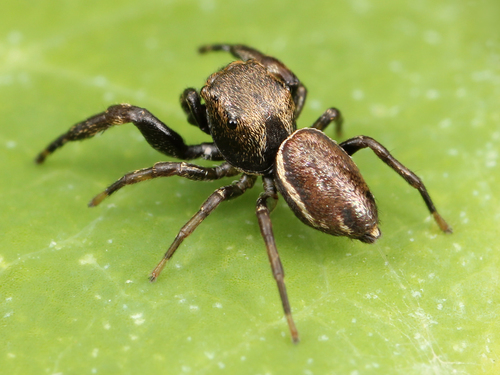
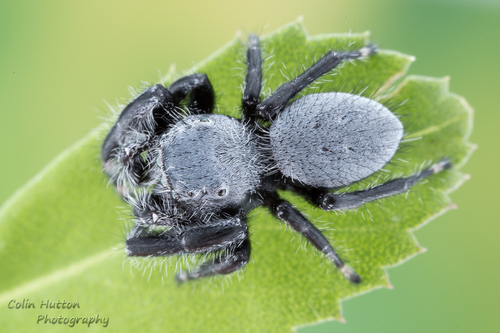
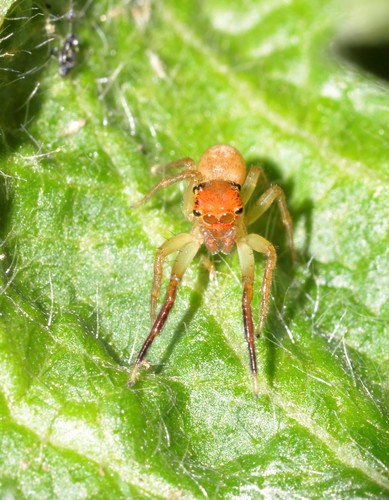
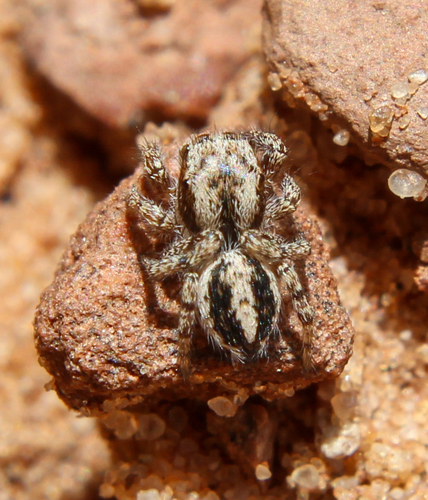
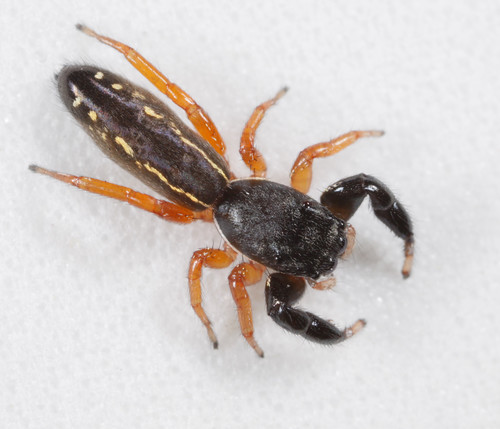
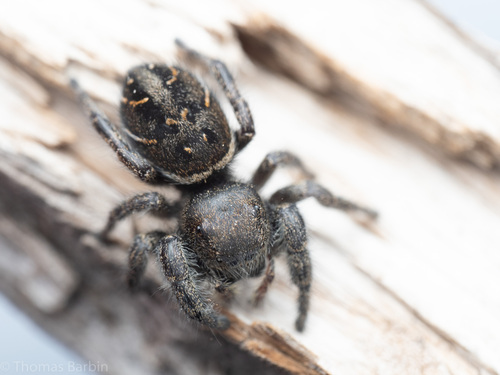
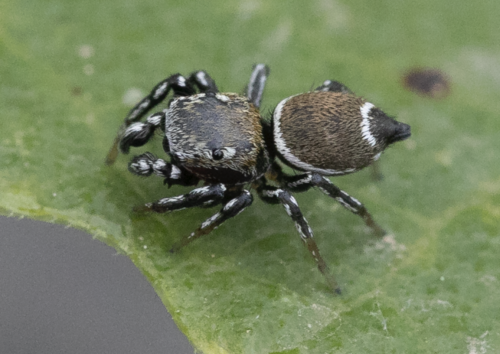
Adult male Heliophanus tribulosus Simon, 1868 reach a body length of approximately 3–5 millimetres (0.12–0.20 in), while adult females reach 3.5–7 millimetres (0.14–0.28 in). This species has the characteristic feature of reddish-brown cheeks. Like other spiders of this group, these spiders have eight eyes: very large anterior median eyes, with smaller eyes on each side. They have excellent eyesight, which is very useful for their hunting method. Adult males and females show significant sexual dimorphism in body coloration and markings. Young males are quite similar in appearance to females, but develop a completely different appearance after their final moult. Typical adult males are small and primarily black, with red or green iridescence on the abdomen. Their legs are also black, usually with a thin white stripe along the edge. The cephalothorax is hairless, and sometimes has two white spots behind the eyes. The head and the underside of the abdomen are framed by two large whitish circular markings. There are also two white spots on the dorsal side of the abdomen. The base body coloration of females is pale greenish-brown. A distinct light stripe connects the posterior lateral eyes. Females have two bright spots at the tip of the abdomen, two comma-shaped markings on the middle of the dorsal abdomen, and two spots on the posterior abdomen; these markings sometimes merge into a large white circle that outlines the abdomen’s edge. Female legs are entirely yellow, while their pedipalps are distinctly apple green, with color darkening slightly at the tips. This species is distributed across most of Europe, extending eastward to Kazakhstan. It can mostly be found on low vegetation in meadows and forest edges, as well as on sunny rocks or the walls of houses, where it actively chases its prey.