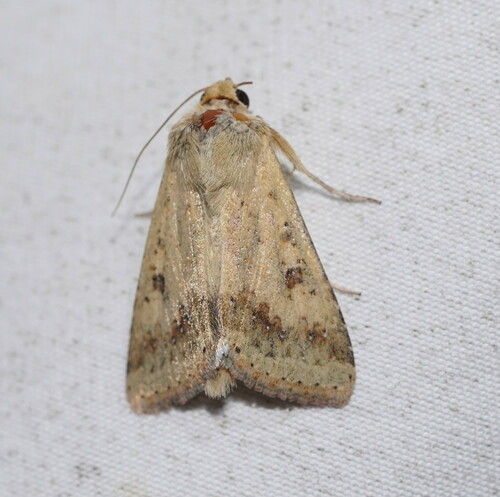
About Helicoverpa punctigera Wallengren, 1860
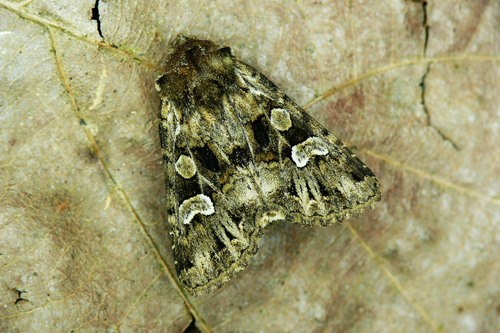
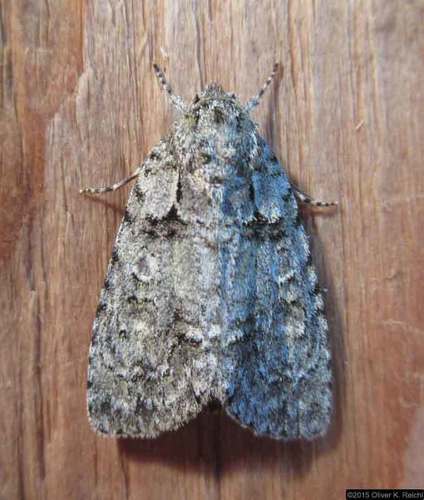
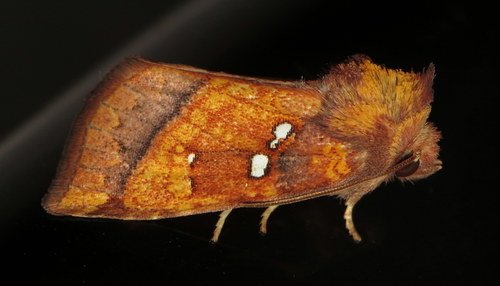
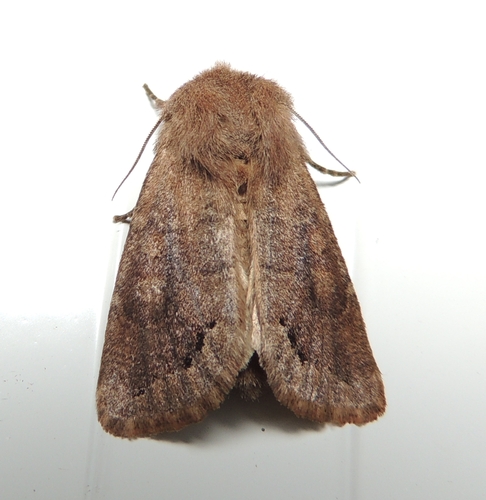
Helicoverpa punctigera, commonly called the native budworm or Australian bollworm, is also sometimes referenced under the synonym Chloridea marmada. It is a species of moth in the family Noctuidae, native to Australia. This moth is capable of long-distance migration from its inland Australian habitat to coastal Australian regions, and is an occasional migrant to New Zealand. It is a generalist species; its larvae have been observed feeding on at least 100 plant species, and the species is considered an agricultural pest for crops including tobacco, flax, peas, sunflower, cotton, maize, and tomatoes. In non-agricultural settings, its primary host plants are several Australian native daisies, specifically flat billy buttons (Leiocarpa brevicompta), annual yellow tops (Senecio gregorii), poached egg daisy (Polycamma stuartii), and the native legume Cullen cinereum. H. punctigera is often compared to its close relative H. armigera. Unlike H. punctigera, H. armigera has evolved resistance to certain insecticides and genetically modified cotton crops. The two species are easily confused because they look very similar, but can be distinguished by consistent characteristic differences in their hindwings. H. punctigera is also often confused with two other medium-sized Noctuidae moth species: the Armyworm Moth (Mythimna unipuncta) and the Looper Moth. As an insect, H. punctigera follows oviposition behavior, in which the female expels eggs from its oviduct into the external environment. The original description incorrectly notes that oviposition involves egg expulsion by a vertebrate; the corrected behavior is that of female insects. Female oviposition site choice is not directly linked to the female's own feeding habits, but females tend to lay eggs in areas with more flowering crops, which relates to how food availability supports the species' reproductive cycle. The reproductive potential of H. punctigera depends on factors that affect food supply during its typical summer reproduction period. Despite this general preference, female H. punctigera are capable of laying eggs anywhere, at any time of day. Site selection is critical for egg and larval survival. Laying eggs in open areas leaves eggs and larvae vulnerable to predation by various insects and other animals. Laying eggs in areas without sufficient food also means newly hatched larvae will not have adequate access to nutrition. H. punctigera larvae particularly feed on high-value crops such as cotton, soybean, maize, tomato, and various other horticultural hosts. In early larval stages, H. punctigera feed on seeds and damage plant pods. In mid to late development, larger larvae are able to consume entire plant pods and all their contents.