About Heliconius sara (Fabricius, 1793)
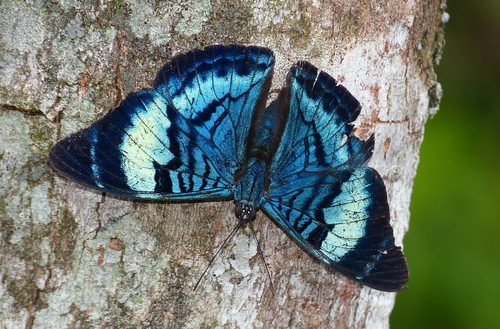
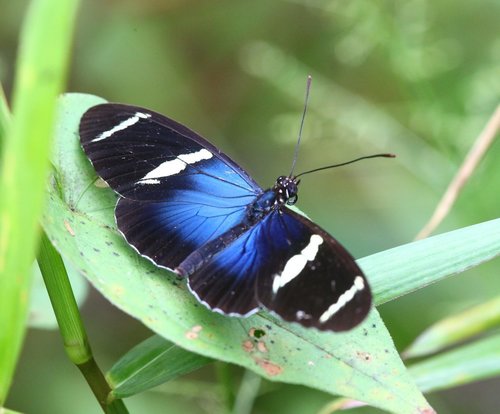
Heliconius sara, commonly known as the Sara longwing, is a neotropical heliconiid butterfly species distributed from Mexico to the Amazon Basin and southern Brazil. This is a colourful species. The dorsal surface of its wings is black, with a large medial patch of metallic blue that is framed by two white bands on the forewings. This colour pattern is similar to that of Wallace's longwing, Heliconius wallacei, whose range overlaps with that of the Sara longwing, but does not extend as far north. The ventral wing surface ranges from dull brown to black, with muted bands and small red spots on the proximal margin. The total wingspan of this species measures 55–60 mm. The Sara longwing inhabits rainforests, and adults are commonly found in sparser secondary growth and along forest margins. Adults feed on nectar from plants of the genera Hamelia, Lantana, Palicourea, and Psiguria. This species reproduces continuously, producing several generations each year. Sara longwings are one of several heliconiid species that exhibit the unusual behaviour of pupal mating: adult males are attracted to female pupae by the pupae's pheromones. Males compete for good perching spots close to the females' chrysalids, and successful males mate forcibly with females immediately after females emerge from their chrysalids. Males may also patrol a territory to search for females that have already emerged. The adult lifespan of the Sara longwing is 2–3 months. Like other heliconiids, female Sara longwings look for new growth on passion flower vines to lay their small yellow eggs, laying clusters of 10 to 50 eggs at a time. Passion flower vines contain toxic compounds, and Sara longwing caterpillars are immune to these toxins. As caterpillars feed on the vines, they concentrate the toxins in their tissues. After pupation, which takes place on the host vine with the chrysalis camouflaged to look like a leaf, the adult butterfly retains these toxins, which protect it from predators.