About Heliconius charithonia (Linnaeus, 1767)
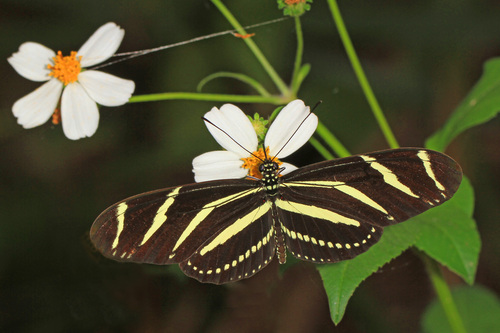
The caterpillars of Heliconius charithonia are white with black spots, and have many black spikes along their bodies. Adult butterflies are medium-sized, monomorphic, and have long wings. The dorsal surface of the wings is black with narrow white and yellow stripes. The ventral wing surface has a similar pattern, but is paler and marked with red spots. Adult wingspans measure between 72 and 100 mm. This species occurs in South America, Central America, the West Indies, Mexico, and the Southeastern United States. During warmer months, adult butterflies sometimes migrate north as far as New Mexico, South Carolina, and Nebraska. The geographic range of H. charithonia overlaps with the ranges of other butterfly species, which can sometimes lead to conflict. One example of this conflict is the overlapping range between H. charithonia and the gulf fritillary Dione vanillae. When populations of the subspecies Heliconius charithonia vazquezae and gulf fritillaries breed in the same overlapping geographic area, H. charithonia vazquezae will compete with and fight gulf fritillaries. In 1996, H. charithonia was declared the official state butterfly of Florida, United States. The species commonly inhabits tropical hammocks, moist forests, forest edges, and fields. At the time of adult emergence (eclosion), the population sex ratio is heavily biased toward females. For the rest of the year, the overall sex ratio is biased toward males, with males making up 68% of the population. This difference in sex ratio occurs because males typically stay close to their birth site to search for mates, while females move around to find egg-laying (oviposition) or feeding sites on Passiflora plants. Because females are highly mobile, males rarely mate with their relatives, so this species has very low inbreeding rates.