About Helicolestes hamatus (Temminck, 1821)
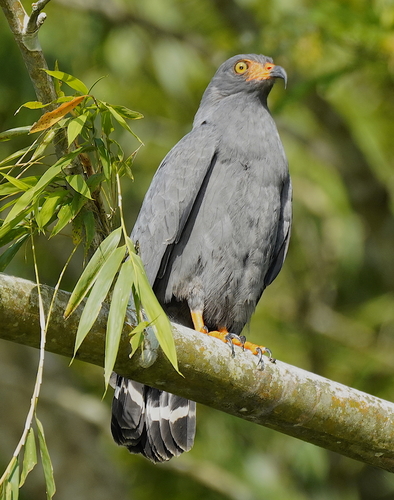
The slender-billed kite (scientific name Helicolestes hamatus, originally published as (Temminck, 1821)) is a slaty gray kite with broad, rounded wings and a short, square tail. Adults of this species measure between 36 and 41 centimeters in total length, with a wingspan ranging from 80 to 90 centimeters. This species does not show sexual plumage dimorphism, but females are typically larger than males: females weigh between 367 and 485 grams, while males weigh between 377 and 448 grams. The species has a characteristic hooked, sharp black beak, paired with sharp black talons. Its eyes are yellowish, and its face and legs are orange-red. Juvenile slender-billed kites resemble adults, but have brownish eyes and three narrow white bands on the tail. Both sexes of the slender-billed kite look very similar to male snail kites, and the slender-billed kite has often been placed in the same genus as snail kites, Rostrhamus. Adult slender-billed kites can be distinguished from snail kites by their yellow eyes (rather than the red eyes of snail kites), a noticeably shorter tail, shorter wings, and a more slender beak. Nestling slender-billed kites have plumage that more closely matches the plumage of adult slender-billed kites, compared to how closely nestling snail kites match the plumage of adult snail kites. The primary call of the slender-billed kite is a nasal kee-ee-aay-aay-aay, which starts with a sharp increase in frequency followed by a steady decrease. This call is most often heard while the kite is in flight, or when it responds to predators. Its second call is a repeating ker-ah with oscillating frequency, sometimes followed by repeating ah-ahs, which is heard when the kite approaches its mate at the nest.