About Helicodiceros muscivorus (L.f.) Engl.
Scientific name: Helicodiceros muscivorus (L.f.) Engl.
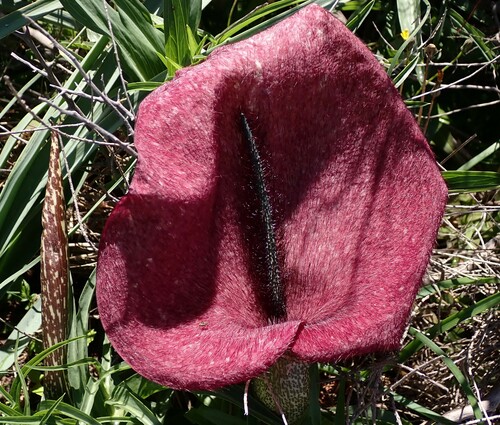
Like other arum lilies, this species has a three-part inflorescence with a spadix that resembles the anal region of a dead mammal. A hairy spathe extends like a tail down into the plant’s floral chamber, connecting to the fertile male and female florets. The appendix and male florets are thermogenic, each following a different temporal pattern. Exit for blow flies that enter the chamber to reach female florets is blocked by spines and filaments, which trap the flies inside. Heat production in male florets is independent of ambient temperature, and instead follows the time of day. Uncoupling protein has been found in both the thermogenic male florets and the appendix. In this dead horse arum, the mRNA for this protein is 1178 nucleotides long excluding the poly-A tail, and the protein is thought to consist of 304 amino acids. The protein has three mitochondrial carrier signature domains, six membrane-spanning domains, and one nucleotide-binding domain. Its uncoupling protein shares typical features with uncoupling proteins found in potato and rice, which have been compared to this plant for this reason. Uncoupling protein functions to generate energy that becomes heat.
Dead horse arum follows a two-day pollination process. An individual flower is only able to receive pollen for one day, and its male parts are usually not mature on this receptive day. On the second day, the male parts produce pollen, but the female part has already shrivelled and can no longer receive pollen. Both of these features encourage outcross pollination from other plants and prevent self-pollination. When the plant is ready for pollination, it produces heat and releases an odour like rotting flesh. This scent attracts blow flies into the plant’s floral chamber. Once inside, the flies are trapped by spines that block the exit. Flies carrying pollen from earlier visits to other plants deposit this pollen onto the female florets as they search for a place to lay eggs. The flies stay trapped overnight, and the blocking spines stay erect until the male florets positioned at the chamber entrance start producing pollen. By this stage, the female florets are no longer receptive to pollen. At this point, the spines wilt, allowing the flies to exit. As the flies leave, they pass through the male florets and become coated with new pollen that they will carry to another dead horse arum plant. Known pollinators of this species include certain blow flies such as Calliphora vomitoria.