About Helichrysum splendidum (Thunb.) Less.
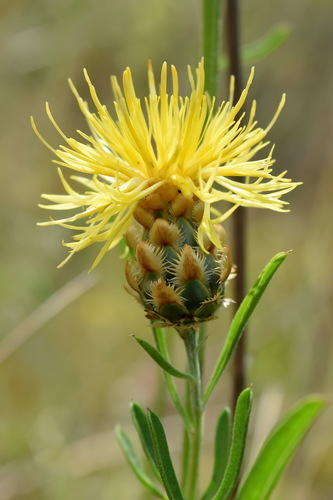
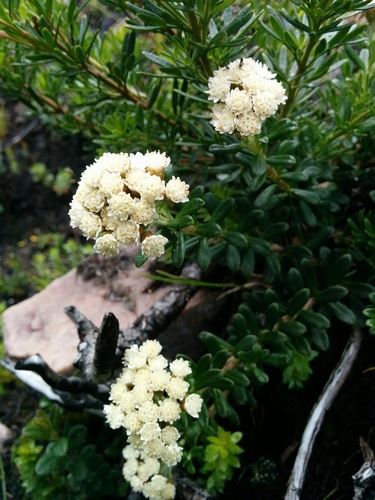
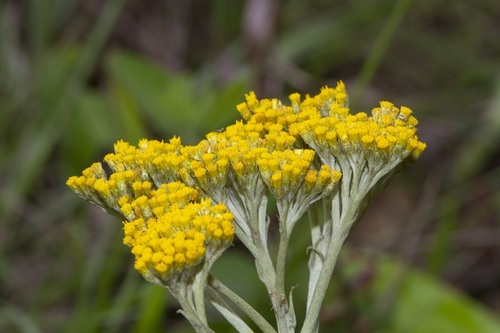
Helichrysum splendidum (Thunb.) Less. is a species of flowering plant in the family Asteraceae, native to parts of Africa and Yemen. A hardy evergreen perennial, it grows along the eastern escarpment mountains from the Southern Cape to Ethiopia. It favours rocky habitats in the fynbos, grassland, and savanna biomes. It forms mound-shaped groups 1–2 meters high, and sometimes grows across entire hillsides. It has been recorded in South Africa, Eswatini, Lesotho, Tanzania, Ethiopia, South Sudan, Malawi, Zimbabwe, Zambia, and Yemen. The distribution of this species is described as anthropogenic, meaning it is closely linked to human movement throughout history. This plant is a virgate shrub growing up to 1.5 m tall, and rarely grows with a sprawling form. Its branches are thinly covered in grey wool, and are closely packed with leaves; older plant parts become glabrescent and rough with visible leaf scars. Its leaves measure 10–30 (–40) by 1–2 (–6) mm, and are shaped linear, linear-oblong, or linear-lanceolate. Leaf tips are acute or subacute, with a small mucronate point, and the broad leaf base half-clasps the stem. Leaf margins are commonly revolute. The upper leaf surface may be thickly or thinly covered in greyish-white wool, or glabrous or nearly glabrous; the upper surface is also distinctly parallel-veined and grooved, with veins protruding from the lower leaf surface. The lower leaf surface is covered in greyish-white wool. Young stems share the same softly woolly texture as leaf undersides, and leaves are blue-grey in colour. Its flower heads are heterogamous and hemispherical, 4–5 mm long, and measure 5–8 mm across the radiating bracts. The bases of the flower heads are woolly, and many heads are arranged in congested or open corymbose panicles that terminate long leafy branches. The involucral bracts are arranged in approximately 5 graded, loosely imbricate series. Inner involucral bracts are about equal to or slightly longer than the flowers, with minutely radiating tips that are glossy bright canary-yellow, and rarely orange. The receptacle is very shortly honeycombed. This species produces 47–105 yellow flowers per head: 8–14 are female, and 39–84 are homogamous. Its achenes are 0.75 mm long, and bear duplex hairs. It has many pappus bristles that match the length of the corolla, are scabrid, and have bases that cohere via patent cilia. H. splendidum is grown in cultivation, and has received the Royal Horticultural Society's Award of Garden Merit. Helichrysums are a rich source of traditional medicines in South Africa. This species has pleasantly aromatic leaves, which can be processed to produce an essential oil used in aromatherapy. The main components of this essential oil are β-pinene, β-phellandrene, δ-cadinene, germacrene D, and 1,8-cineole.