About Helichrysum petiolare Hilliard & B.L.Burtt
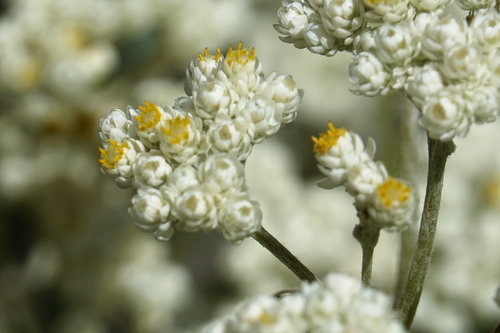
Helichrysum petiolare, commonly called the licorice plant or liquorice plant, is a flowering plant species belonging to the family Asteraceae. It is an evergreen trailing subshrub native to the Cape Provinces of South Africa, where it is known as impepho, as well as to Angola, Zambia, and Zimbabwe. It has become naturalized in parts of Portugal and the United States. It grows to around 45 cm (18 in) tall and 150 cm (59 in) wide, with fuzzy grey-green leaves and small white flowers. Additional common names for this species include silver-bush everlastingflower, trailing dusty miller, and kooigoed. Its foliage carries a faint licorice scent, but Helichrysum petiolare is not closely related to true liquorice, Glycyrrhiza glabra, the plant used to make liquorice candy. Helichrysum petiolare is cultivated for its foliage and as a groundcover. It grows best in full sun to partial shade with well-drained soil, as it is susceptible to root rot. It is hardy in USDA zones 9 to 11, suited to mild or coastal areas where temperatures do not stay below freezing for extended periods, and requires a sheltered spot in full sun. Numerous cultivars have been developed for garden use, and some of these have earned the Royal Horticultural Society's Award of Garden Merit. The species' Afrikaans common name kooigoed translates to "bedding stuff", and it is still used to make soft, aromatic mattresses. Research has been conducted on the anti-microbial, anti-oxidant, and anti-inflammatory properties of its essential oil. It forms a component of traditional African medicine in South Africa. Boiled leaves and twigs are prepared as a tea to soothe coughs and fever. Leaves are also applied directly to wounds to prevent infection, and the plant is ceremonially burned to create traditional incense. In African traditional medicine, illness is often attributed to the influence of spirits or ancestors, and the ritual use of impepho is believed to invoke and placate ancestors and drive away malicious spirits. This makes impepho a very important medicinal plant within this traditional medical system. Beyond its traditional use, impepho has been widely researched in recent years, and a large body of both scientific and anecdotal evidence appears to support the claims of traditional healers. Impepho is traditionally used as a wound dressing; it has confirmed anti-microbial properties, and appears to work effectively as pain relief and an anti-inflammatory, an effect likely caused by its content of various volatile oils and flavanoids. Ash from burnt impepho, alongside fresh or dried aerial parts of the plant, are common ingredients in wound dressings. Burning the plant causes chemical changes that alter its healing properties. The plant's oils are said to be valuable for healing scars and acne, and impepho is believed to stimulate cellular regeneration. When boiled in water or milk to make tea, it is used internally to treat coughs, colds, fever, infection, menstrual pain, headaches, insomnia, hypertension, allergies, and diabetes. For pain relief and to treat coughs, colds, bronchitis, and other chest infections, the plant is burned and the smoke inhaled. No evidence is available to confirm how effective impepho is for treating tuberculosis, and its common use in regions where the illness is widespread suggests it may be ineffective. The papery flowers of many Helichrysum species come in a range of colors, with bright to dull yellow, white, pink, and orange being the most common. These flowers are popular in flower arrangements and have been used in potpourri. In traditional African rituals and ceremonies, impepho is burned in large quantities. It is typically burned indoors, traditionally in poorly ventilated huts, where it acts as incense in amounts that function similarly to fumigation. Before and during consultations with ancestors for divination, seeking wise counsel and insight, or other purposes, traditional South African healers called sangomas burn impepho. The aerial parts of the plant (leaves, twigs, and flowers when in bloom) are collected, tied into tight bundles, and dried. A dried bundle can smoulder for a long time and produce a large amount of smoke. Burning impepho acts as a ritual offering to invoke, honor, and placate ancestors. The plant is primarily used in traditional ceremonies, rituals, and African traditional medicine, but it may also be used occasionally by private individuals to ward off evil, dispel negativity, support meditation, or for similar purposes. Despite having mild psychoactive properties, it is not commonly used recreationally as a mind-altering or consciousness-expanding herb. Unlike many plants used in traditional medicine and shamanism that are ascribed magical properties, Helichrysum species do not contain alkaloids. Instead, a mixture of flavanoids, volatile oils, sesquiterpenoids, and acylated phloroglucinols appears to mimic the effects of alkaloid compounds on the central nervous system. To experience the effects of impepho, a large amount of smoke must be inhaled over a long period. Common effects experienced by people inhaling impepho smoke include euphoria, ecstasy, uncontrolled giggling, and sedation. Violent mood swings, mental confusion, and personality changes have not been reported. Rarer symptoms are often connected to African traditional beliefs: mild hallucinations such as seeing everything bathed in a gentle golden light are interpreted as visions, and instances of "speaking in tongues" have been recorded. It remains uncertain whether these effects come from the plant itself or the psychological state of people participating in the rituals. There is no evidence that even prolonged heavy use of impepho leads to physical or psychological dependence, and no evidence links prolonged use to health problems, with the possible exception of risks associated with smoke inhalation. While impepho is an important, revered part of African traditional medicine and rituals, little to no effort has been made to protect the areas where the plant commonly grows, likely because the species is very common across Southern Africa. Although its use in rituals and ceremonies is most often tied to African traditional beliefs, it is commonly burned as incense in South African Christian churches, where its use is seen as similar to that of frankincense and not connected to honoring ancestors. The plant is widely available and usually sold for very low cost, and it remains unclear whether it is generally considered a holy or sacred plant. It is believed to increase the spiritual awareness and psychic abilities of people who use it. South African law protects the right of individuals to burn impepho as part of ceremonies and rituals connected to traditional beliefs. Dried impepho bundles are usually burned in a shard of pottery placed in the middle of a typically poorly ventilated room or hut. Smoking impepho through a pipe or as a cigarette is not practiced. The smoke's scent is not always appreciated; it has been described as similar to mildew and camphor, with underlying notes of fenugreek.