About Helichrysum aureonitens Sch.Bip.
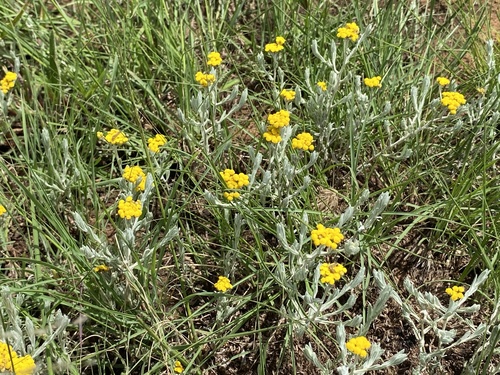
The genus Helichrysum is in the sunflower plant family (Asteraceae), with an estimated 600 flowering plant species. Its type species is Helichrysum orientale. Members of this genus are commonly called everlasting, immortelle, and strawflower. The genus name comes from the Ancient Greek words helios (meaning sun) and chrysos (meaning gold). Helichrysum occurs naturally in Africa, which hosts 244 species in South Africa alone, as well as Madagascar, Australasia, and Eurasia. Plants in this genus can be annuals, herbaceous perennials, or shrubs, and reach a height of 60–90 cm (24–35 inches). The genus was historically a wastebasket taxon, and many of its former members have been reclassified into smaller genera — most notably, the plants previously called everlastings are now placed in the genus Xerochrysum. Helichrysum leaves range from oblong to lanceolate in shape, are flat, and have pubescent (fuzzy hairy) texture on both sides. The bristles of the pappus may be scabrous, barbellate, or plumose. The receptacle, the base of the flower head, is often smooth, has a fringed margin, or is honey-combed, and Helichrysum flower heads resemble daisies. Flowers of the genus come in almost all colors, with the exception of blue. Most species produce many individual flower capitula arranged in generally flat-topped corymbs or panicles. The corolla lobes have glandular hairs on their abaxial (lower) surface. Helichrysum species are used as food plants by the larvae of some Lepidoptera species. This includes bucculaticid leaf-miners: Bucculatrix gnaphaliella, which feeds exclusively on Helichrysum arenarium, and Bucculatrix helichrysella, which feeds exclusively on H. italicum. It also includes Coleophora case-bearers: C. caelebipennella, C. gnaphalii, which feeds exclusively on H. arenarium, and C. helichrysiella, which feeds exclusively on H. italicum. Several Helichrysum species are grown as ornamental plants, and are cultivated for dried flowers. When cut young and dried, the open flowers and stalks retain their color and shape for long periods of time. Helichrysum italicum, which has the synonym Helichrysum angustifolium, is steam distilled to produce a yellow-reddish essential oil. This oil is popular in fragrance for its unique scent, best described as herbaceous, sweet, and honey-like. The species epithet angustifolium means narrow-leaved, and it is commonly misspelled as augustifolium.