About Helianthus petiolaris Nutt.
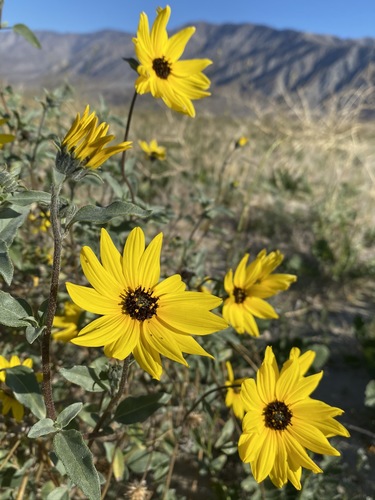
Helianthus petiolaris Nutt., commonly called prairie sunflower, is an annual plant with a taproot. It grows up to 120 cm (4 ft) tall. It has an erect, hairy stem. Its leaves are arranged alternately, are lanceolate in shape, rough in texture, bluish-green in color, and measure between 2 and 5 inches long. The flowers closely resemble those of a common sunflower, and are hermaphroditic, containing both male and female reproductive parts. This species originally grew in dry prairies across Minnesota, Oregon, Texas, the Dakotas, California, and other states in Western and Central United States. It has since expanded its range across Eastern United States, and into central and western Canada. Today, it is the most widely distributed sunflower species besides Helianthus annuus. Prairie sunflower most commonly grows in sandy areas, but can also grow in heavy clay soil and dry prairies. It cannot grow in shady locations, and requires full direct sunlight. It grows best in dry to moist soil. It blooms annually between June and September. The seeds of this plant are edible; they can be ground into an oily meal or into a butter. Powdered leaves of prairie sunflower are said to help heal sores and swellings. Three varieties of Helianthus petiolaris are recognized: Helianthus petiolaris var. canescens A.Gray, found in Arizona, California, Nevada, New Mexico, Texas, and Chihuahua; Helianthus petiolaris var. fallax (Heiser) B.L.Turner, found in Arizona, Colorado, Nevada, and Utah; and Helianthus petiolaris var. petiolaris, found across most of the species' full range.