About Helianthus debilis Nutt.
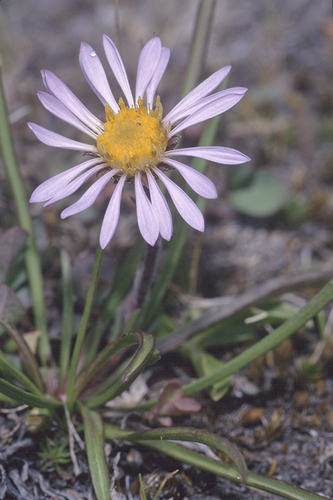
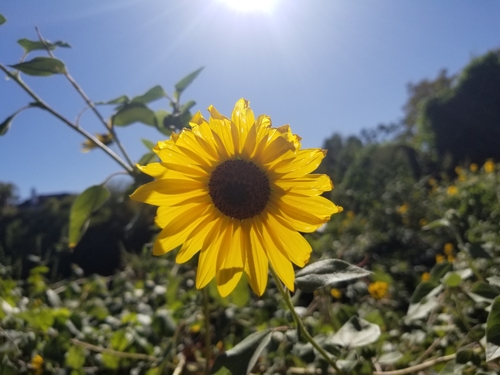
Helianthus debilis Nutt. is a species of sunflower with multiple common names: cucumberleaf sunflower, beach sunflower, weak sunflower, East Florida beach sunflower, and East Coast dune sunflower. It is native to the United States, occurring naturally along the Atlantic and Gulf Coasts. It has been introduced outside its native range to areas including South Africa, Australia, Taiwan, Slovakia, and Cuba. This species can be an annual or perennial herb. It is typically perennial, but only lives one growing season in climates with freezing temperatures. It can grow up to 2 meters tall. Its stem grows from a taproot, and can be erect or decumbent. It can also spread along the ground to form a dense groundcover. Its leaves are usually alternately arranged, and vary widely in shape and size. The largest leaves can reach up to 14 centimeters long by 13 centimeters wide. Its showy inflorescence is either a single flower head, or a cluster of two or three heads. It has up to 30 lance-shaped phyllaries, each up to 1.7 centimeters long. It can bear up to 20 or 21 ray florets, each up to 2.3 centimeters long. Wild ray florets are usually yellow, but cultivated varieties have been bred to produce whitish, reddish, or orange florets. The center of the flower head is filled with many disc florets that can be red, yellowish, or purplish. Its fruit is a cypsela, roughly 2 to 3 millimeters long. Several subspecies of Helianthus debilis exist. Eight subspecies were recognized at one point, but five are currently accepted. Helianthus debilis subsp. cucumerifolius, the cucumberleaf sunflower, is the subspecies with the widest distribution. Helianthus debilis subsp. debilis, the beach sunflower, is endemic to Florida. Helianthus debilis subsp. silvestris, the forest sunflower, is endemic to Texas. Helianthus debilis subsp. tardiflorus, the slow-flowering sunflower, ranges from Mississippi to Florida and is limited to rare, specialized coastal habitat. Helianthus debilis subsp. vestitus, the clothed sunflower or hairy beach sunflower, is endemic to Florida. It is considered imperiled, with only around 22 known occurrences. This species grows in multiple types of coastal habitat, and sometimes grows directly on the beach. It tolerates moderately saline environments, but cannot withstand excessive salt spray or inundation. It is highly drought-tolerant, and can grow in low-nutrient, poor soils including alkaline soils, acidic soils, and sand. The plant attracts butterflies, and birds feed on its fruits. Helianthus debilis is grown as a garden flower, and is also used for landscaping, particularly in poor, dry soils. It is planted on beaches to form a sand-binding groundcover that prevents erosion and stabilizes dunes. It rarely, if ever, needs supplemental watering. It may look unkempt after its showy flowers wither. Known cultivars include 'Italian White', 'Flora Sun', 'Dazzler', 'Excelsior', and 'Orion'.