About Helianthus californicus DC.
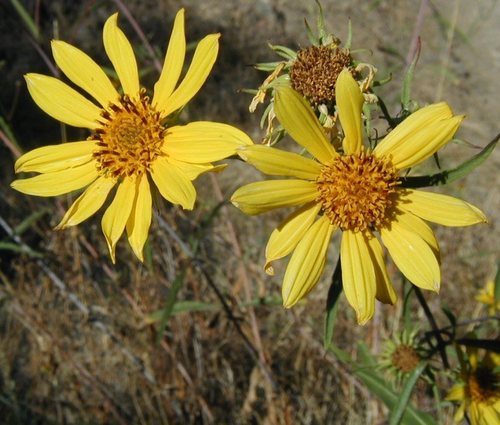
Helianthus californicus DC. is an erect perennial herb that grows from a network of tough, woody roots with small rhizomes. It is a sprawling, gangly plant that produces a thin stem that reaches heights between 1 and 3 meters (3–10 feet) or more. Its lance-shaped leaves can be up to 20 centimeters (8 inches) long, with smooth or slightly toothed edges. Its inflorescence holds several flower heads. Each flower head is supported by a base covered in long, pointed phyllaries that bend backward as the head ages and develops fruit. The flower head has a fringe of 15 to 25 golden yellow ray florets, each 2 to 3 centimeters (3⁄4–1+1⁄4 inches) long, and a center filled with curly yellow and brown disc florets. The dry, achene fruits (commonly called sunflower seeds) are small, only about 5 millimeters (¼ inch) long, and are dispersed by birds, animals, or wind. These seeds develop from the disc florets in the center of the flower head. This species is endemic to California, with its range extending slightly into northern Baja California. It occurs from Del Norte County to San Diego County, reaching east into the Sierra Nevada foothills, and generally grows below 1,600 meters (5,200 ft). It thrives in a variety of often moist open habitats. It often forms loose colonies through rhizomatous growth, especially in the Bay Area, Central Valley, and along the California coastal foothills, where it contributes to the structure of native vegetation communities. Distribution maps for the species are available through the Biota of North America Program (BONAP) and the Jepson eFlora, University of California, Berkeley. In California ecosystems, Helianthus californicus is an important late-season nectar source. It blooms from midsummer through fall, between July and October, when most native plant species have already finished flowering. Its flowers attract pollinators including bees, butterflies, and birds, as well as caterpillars, other insects, squirrels, and bats. The plant's seeds provide food for birds and small mammals, while its deep root system helps stabilize soil and supports soil recovery after fires or droughts. Although the species is classified as Least Concern, it faces habitat pressures from development, invasive species, and increasing wildfires. Despite these challenges, its drought tolerance and rhizomatous growth allow it to persist across most of its native range. For these reasons, Helianthus californicus is frequently used in restoration, erosion control, and pollinator garden projects across California. It can be found growing in state and regional parks, educational campuses, and private gardens, where it demonstrates the resilience and value of California's native wild flora. The common sunflower Helianthus annuus, a close relative of Helianthus californicus, was widely used by Indigenous peoples across California and North America. Common sunflower seeds were eaten raw, roasted, or ground into flour to make cakes and pinole, and the oil was applied to skin and hair, or used medicinally to treat conditions such as snakebites and inflammation. Because Helianthus californicus shares similar morphology and seed composition with common sunflower, it likely filled comparable, though less documented, local uses. Its seeds likely contain the nutritious oils and proteins typical of wild sunflowers, making the species relevant to contemporary research on reviving native food practices.