About Helianthus annuus L.
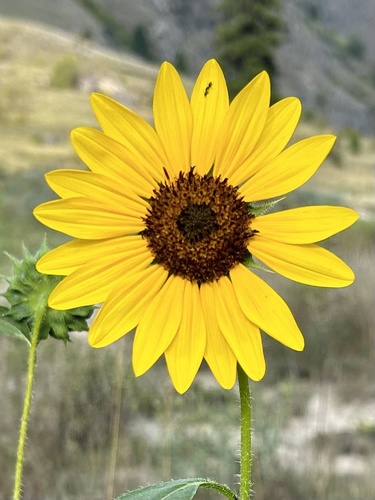
Helianthus annuus L., the common sunflower, has an erect, rough-hairy stem that typically reaches 3 meters (10 feet) in height. The tallest recorded sunflower grew to 10.9 m (35 ft 9 in). Its leaves are broad, coarsely toothed, rough, and mostly arranged alternately; the leaves closest to the base of the stem are the largest and usually heart-shaped. This species was first domesticated in the Americas. Sunflower seeds were brought from the Americas to Europe in the 16th century, where both the seeds and sunflower oil became widely used cooking ingredients. Over time, most large-scale industrial production of sunflowers has shifted to Eastern Europe. As of 2020, Russia and Ukraine together produce more than half of the world’s total sunflower seed supply. Sunflowers grow best in fertile, moist, well-drained soil with heavy mulch. They commonly grow in dry open areas and on foothills. When growing outside of cultivation, common sunflowers are found on moist clay-based soils in climates that match that of Texas. This differs from related species Helianthus debilis and Helianthus petiolaris, which grow in drier, sandier soils. The exact native range of common sunflower is hard to confirm. According to Plants of the World Online (POWO), it is native to Arizona, California, and Nevada in what is now the United States, and to all of Mexico except the Gulf Coast and southeast. While it does not provide many details, the Missouri Botanical Garden Plant Finder also lists common sunflower as native to the Western United States and Canada. Information from the Biota of North America Program (BONAP) largely matches this, marking common sunflower as native to US states west of the Mississippi River, but also listing it as a noxious weed in Iowa, Minnesota, and Texas. Regardless of its original native range, common sunflower can now be found growing wild in nearly every region of the world that is not tropical, desert, or tundra. For commercial cultivation, seeds are planted 45 cm (1 1/2 ft) apart and 2.5 cm (1 in) deep. Researchers have studied the effects of various nitrogen-based fertilizers on sunflower growth. They found that ammonium nitrate supports better nitrogen absorption in sunflowers than urea, while urea performs better than other options in low-temperature growing areas. Whole sunflower seeds (the plant’s fruit) are sold as a snack food, sold raw or roasted in ovens, with or without added salt and/or seasonings. Sunflower seeds can be processed into sunflower butter, an alternative to peanut butter. Sunflower seeds are also sold as bird food, and can be used directly in cooking and salads. In the past, Native Americans used sunflowers for many purposes, including making bread, medical ointments, dyes, and body paints. Sunflower oil, extracted from sunflower seeds, is used for cooking, as a carrier oil, and to make margarine and biodiesel, since it is less expensive than olive oil. Different sunflower varieties have different fatty acid compositions; some high-oleic varieties have a higher content of monounsaturated fats in their oil than even olive oil. The oil is also sometimes used to make soap. After World War I, during the Russian Civil War, people in Ukraine used sunflower seed oil in lamps as a substitute for kerosene to cope with supply shortages. The light produced by these lamps has been described as "miserable" and "smoky". The solid cake left after seeds are processed for oil is used as livestock feed. The seed hulls removed during dehulling before oil extraction can also be fed to domestic animals. Some recently developed sunflower cultivars have drooping heads. These cultivars are less popular with gardeners growing sunflowers as ornamental plants, but are preferred by farmers because they reduce bird damage and losses from certain plant diseases. Sunflowers also produce latex, and are the subject of experiments to improve their suitability as an alternative crop for growing hypoallergenic rubber. Traditionally, several Native American groups planted sunflowers along the northern edges of their gardens as a "fourth sister" to the well-known Three Sisters planting combination of corn, beans, and squash. Annual sunflower species are often planted for their allelopathic properties. Native Americans also used sunflower to dress hair. Among the Zuni people, the medicine man chews the fresh or dried sunflower root before sucking venom from a snakebite, then applies a root poultice to the wound. This compound root poultice is applied with extensive ceremony to rattlesnake bites. However, for commercial farmers growing other commodity crops, wild sunflower is often considered a weed. Especially in the Midwestern United States, wild perennial sunflower species are commonly found in corn and soybean fields and can lower crop yields. This yield reduction is caused by phenolic compounds that common sunflowers produce to reduce nutrient competition when growing in low-nutrient areas.