About Helianthemum almeriense Pau
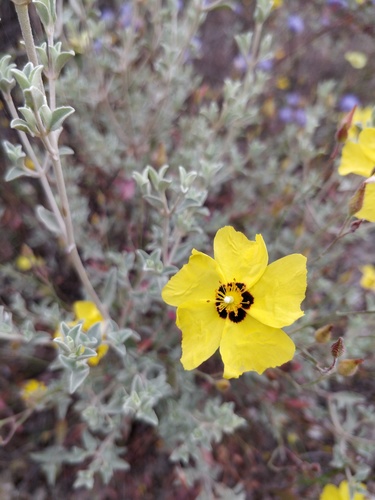
Helianthemum almeriense Pau is a perennial, fruticose shrub that grows 8 to 60 cm tall. It is intricately branched, forming a more or less twisted growth habit, and its branches are generally divaricate. Stems are spreading and divaricate, rarely erect-ascending, ranging from glabrous to incano-tomentose, and are reddish-brown in color.
Leaves are most often elliptic, oblong-lanceolate, or linear-lanceolate, and rarely suborbicular. They have obtuse tips, are usually flat, and only rarely have somewhat revolute margins. The upper leaf surface ranges from glabrous to sparsely stellate-pubescent, while the lower surface is typically glabrous, and only rarely stellate-pubescent or tomentose. Lateral leaf veins are generally not very prominent. Leaf blades measure 2–18 mm long by 0.6–4 mm wide. Stipules grow up to 2–3.5 mm long, can be shorter or longer than the petiole, and are subulate or triangular-subulate. Their apex is often piliferous, and they range from glabrous to more or less hairy, and are green in color.
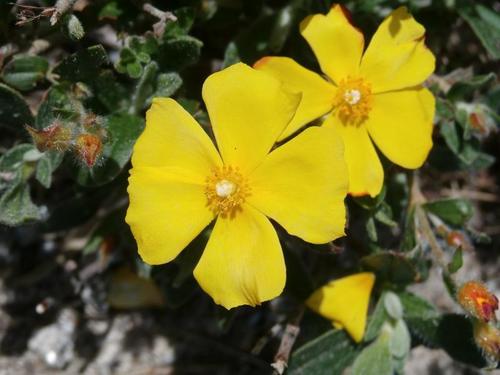
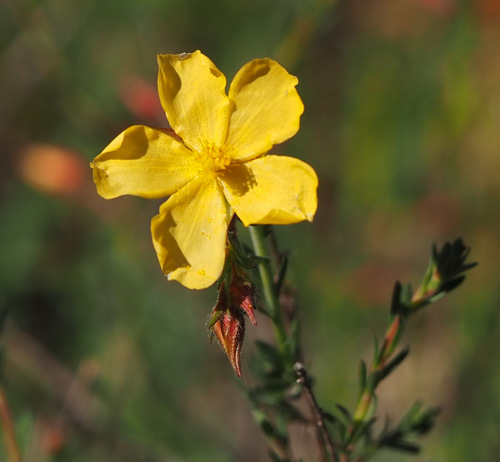
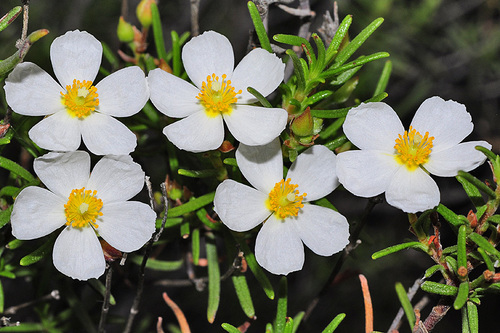
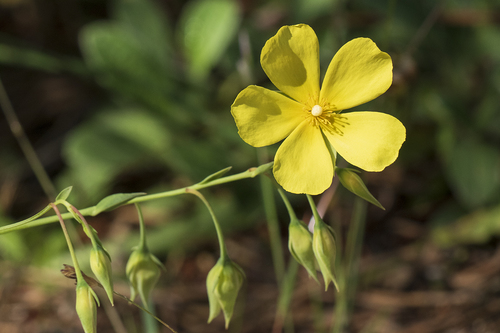
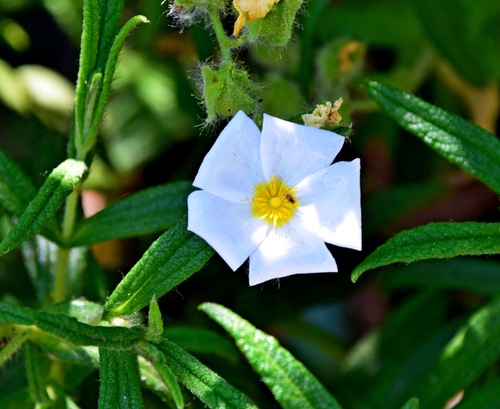
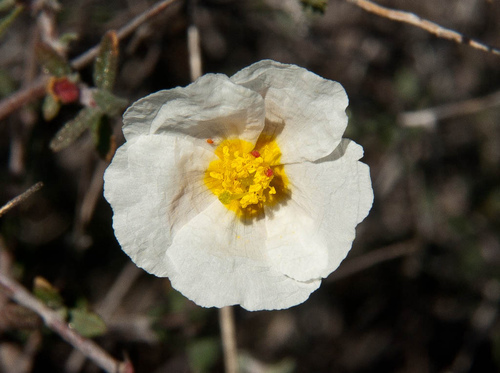
The inflorescence is simple, somewhat lax, and holds 2 to 10 flowers. Flower buds are ovoid-conical, acute, and have a distinctly twisted apex. Inner sepals measure 4–8 mm long, growing to 5–8.5 mm when fruiting; they are obliquely ovate-elliptic, subobtuse, membranaceous, usually glabrous, less frequently stellate-pubescent, and generally purplish. They have prominently ribbed veins, with intercostal spaces reaching a maximum width of about 1 mm, and are rarely setose. Outer sepals are linear-spatulate to elliptic, about 1/3 the length of the inner sepals, glabrous or glabrescent, and greenish. Petals are 6–12 mm long, obovate-flabelliform, somewhat wrinkled, sometimes retuse, usually white, more rarely pinkish, and have colored spots. The fruit is a 4.5–7 mm capsule, similar in length or shorter than the calyx, globose or ellipsoidal, densely hairy, and contains many seeds. Seeds measure 1.2–1.5 mm, and are brownish or dark reddish brown.
This species grows in thyme fields and cleared open areas, in dry, stony limestone, micaceous, or loamy soils, and in gypsum wastelands. It is sometimes also found in volcanic soils and even on sandy beach soils. It occurs from sea level up to 1200 m in altitude. Its confirmed native range is the arid southeast of the Iberian Peninsula; it has also been reported from Morocco, but its presence there requires confirmation.
Ecologically, Helianthemum almeriense associates with the mycorrhizal desert truffle Terfezia claveryi (also called turma), a member of the family Terfeziaceae. This subterranean truffle is edible, has culinary value, and is used as livestock feed. This association is reflected in the Spanish common names for this species, and other species in the genus Helianthemum, such as Mata turmera and Tormera.