About Helenium autumnale L.
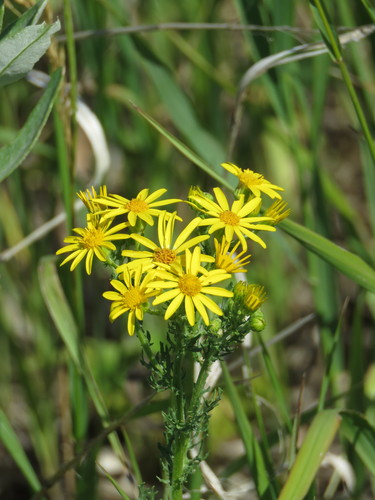
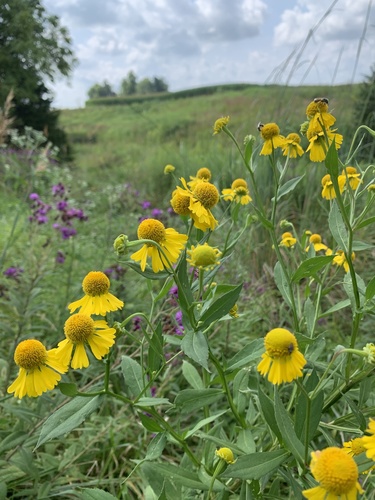
Common sneezeweed, Helenium autumnale L., is a perennial herb that reaches up to 130 cm (51+1⁄3 in; 4+1⁄3 ft) in height. In late summer and autumn, a single plant can grow up to 100 yellow flower heads arranged in a branching cluster. Each flower head holds 11–21 yellow ray florets, which surround a center that can contain up to 800 yellow disc florets. Its leaves are dark green, arranged alternately along stems, and shaped like a lance. The Latin specific epithet autumnale refers to the plant's autumn flowering time. This plant is widespread across most of the United States and Canada, ranging from the Northwest Territories in the north down to far northern California, Arizona, Louisiana, and Florida in the south. It has not been recorded in southern or central California, and has also not been found in the four Atlantic Provinces of Canada. It grows in moist, open locations, including areas along streams and ponds, and wet meadows. The flowers of common sneezeweed attract a wide range of pollinators, such as bees, butterflies, and wasps. Contrary to what its common name suggests, this plant is insect-pollinated rather than wind-pollinated, so it does not cause seasonal allergies or sneezing. It is poisonous to ruminants. Common sneezeweed is grown as a perennial garden plant, with multiple named cultivars that vary in flower color and mature height. 'Pumilum Magnificum' is a yellow-flowered cultivar that grows around two feet tall. 'Bruno' is a reddish-brown cultivar, 'Kupfersprudel' produces yellow or orange flowers, and 'Butterpat' has golden flowers; all three grow to between 91 and 107 centimetres (3 to 3.5 feet) tall. 'Chippersfield Orange' reaches up to 0.91 metres (3 ft) tall, and bears orange flowers streaked with gold.