About Hecatera dysodea (Denis & Schiffermüller), 1775
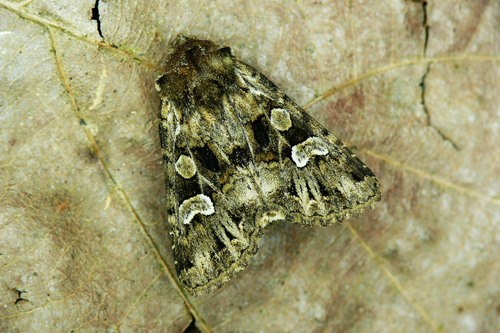
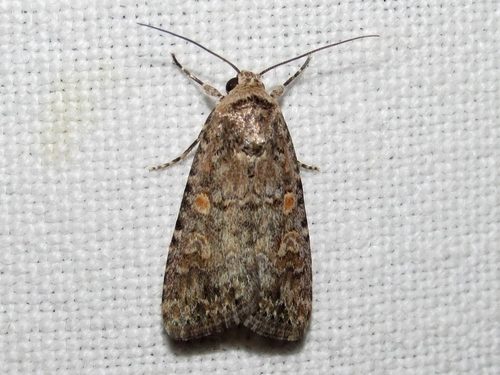
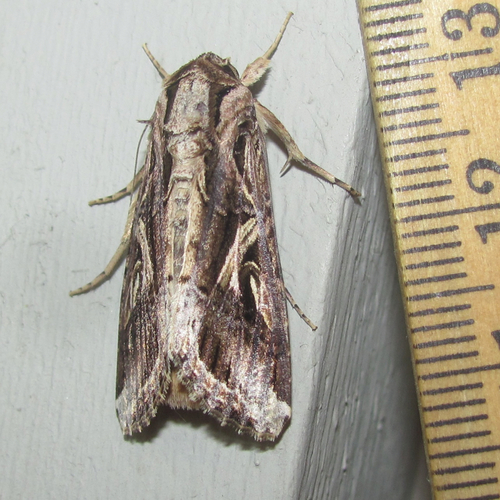
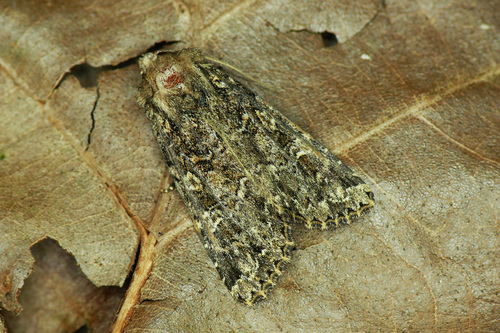
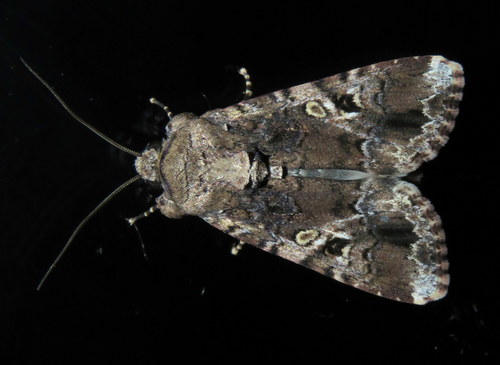
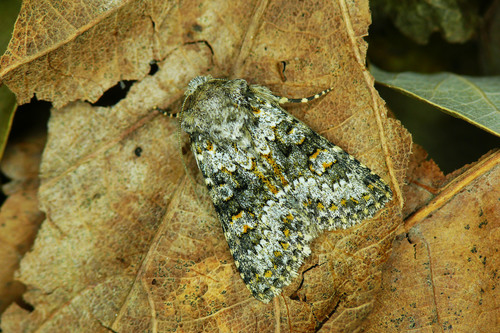
Hecatera dysodea (Denis & Schiffermüller), 1775, commonly called the small ranunculus, is a moth species belonging to the family Noctuidae. This species is native to Europe, with its main range concentrated in Central and Southern Europe. Its northern distribution boundary runs from the Baltic Sea through southern Lithuania, Belarus, and the area south of Moscow, to the Ural Mountains. Its southern distribution boundary is in North Africa, spanning Algeria and Morocco. To the east, the species extends through the Middle East and Turkestan, across the Palearctic region to Central Asia. It is an introduced species in North America, where it was first recorded in Utah in 1998, and then in Oregon in 2005. This moth has a wingspan of 32–34 mm, and forewings that measure 14–15 mm in length. Meyrick's description of the species is as follows: Forewings are whitish, speckled with grey. The median area is suffused with grey and partially mixed with orange. The subbasal line is whitish and edged anteriorly with black mixed with orange. The first and second lines are whitish and edged internally with blackish. Wing spots are outlined in black mixed with orange. The subterminal line is made up of orange spots, preceded by a scattering of black scales. Hindwings are pale grey, with darker suffusion across the posterior region. The larva is pale dull green or yellowish, freckled with brown. It has a pale, dark-edged dorsal line, and a dark indistinct lateral line. Its spiracles are black, and its head is ochreous-brown or dull greenish. Seitz's description of the species (listed under the synonym P. spinaciae Hew., equal to dysodea Schiff, flavicincta-minor Esp., chrysozona Bkh., ornata Vill, ranunculina Haw.) appears on Plate 17. Forewings are pale or greenish-grey, dusted with dark grey, with a darker median area. All lines and markings are highlighted with orange scales. The claviform stigma is dark, while the upper two stigmata are grey. The hindwing is dull grey in males and dark grey in females, with a broad dark border, and dark veins and cellspot. Several forms are recognized: caduca H-Sch. is a pale grey form with very little yellow scaling; in innocens Stg. the median area is blacker, and the inner and outer lines are paler by comparison, with only slight yellow scaling; koechlini Th.-Mg. (= turbida Hofm.) is a darker form with strongly developed orange markings. The species occurs across Europe, and also in Asia Minor, Persia, Syria, Kashmir, Turkestan, and China. The larva is yellow green, freckled with brown, with a pale dark-edged dorsal line.