About Hecastocleis shockleyi A.Gray
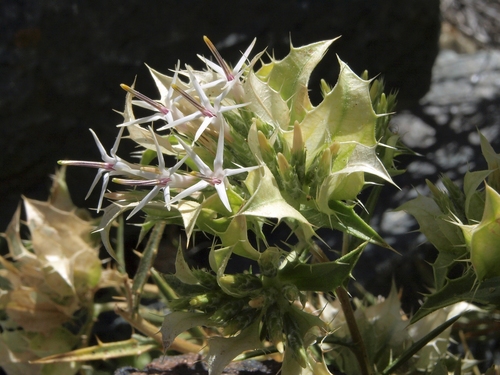
Hecastocleis shockleyi, commonly called prickleleaf, is a xerophytic thorny shrub that usually grows 40–70 cm (1.3–2.3 ft) tall, and occasionally reaches 1.5 m (4 ft 11 in) in height. This species has a chromosome count of 2n=16. Prickleleaf is native to desert plains and mountains in eastern California (Inyo, Mono, Kern, and San Bernardino Counties) and southern Nevada (Mineral, Esmeralda, Nye, Lincoln, and Clark Counties), where it grows on arid, rocky slopes and flats. Documented locations for this species include Mount Charleston, the Nevada Test Site, Grapevine Mountains, and Red Pass. In the mountains bordering the north side of Death Valley, Hecastocleis shockleyi is often one of the dominant shrubs, growing alongside Atriplex confertifolia, Eriogonum fasciculatum, and Tetradymia axillaris. Less dominant, but commonly present shrubs in this community include Ephedra viridis, Ericameria laricifolia, and Lepidium fremontii. No trees occur in this community. Herbaceous plants form an open layer, and regularly include the grasses Achnatherum hymenoides, Bromus rubens, and Poa secunda, alongside Claytonia perfoliata, Cryptantha utahensis, Delphinium parishii, multiple Gilia species, and Phacelia vallis-mortae. Biological soil crust, lichen, and moss can also be found in this plant community. Hecastocleis shockleyi grows primarily on steep, very rocky slopes and bedrock outcrops with northerly aspects, at altitudes between 1250 and 1600 m. It most often grows on calcareous clay loam, loamy sand, or sandy clay derived from the erosion of dolomite, limestone, or shale, in soils that are low in nutrients. Pollination of Hecastocleis shockleyi has not been observed, but because its flowers are white, nocturnal insects are considered likely pollinators.