About Hazardia orcuttii (A.Gray) Greene
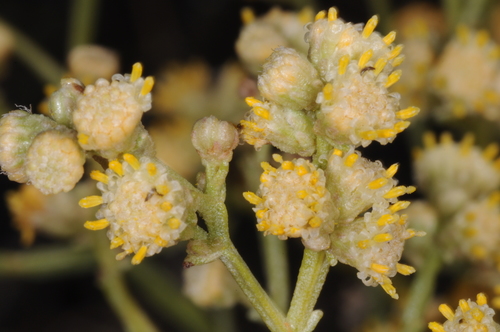
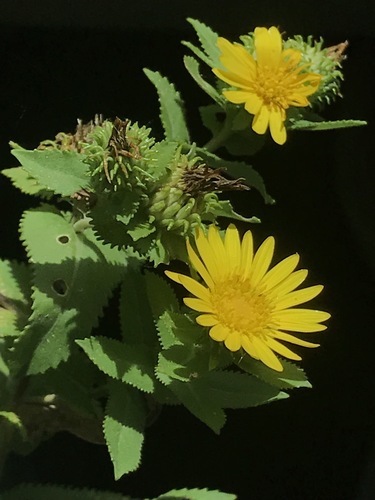
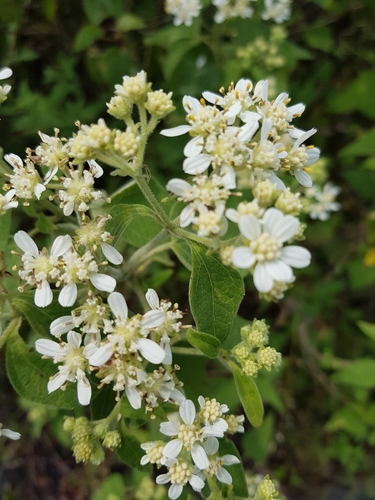
Hazardia orcuttii is a rare North American species of flowering plant in the family Asteraceae, known by the common names Orcutt's bristleweed and Orcutt's goldenbush. It is native to California in the United States and Baja California in Mexico. In California, it is only found in one location within the city of Encinitas, where it grows in and near the protected Manchester Conservation Area. In Baja California, it occurs at between 11 and 17 locations. This is a resinous shrub that grows up to 100 centimetres (39 inches) tall. Its leaves are leathery and pointed, reaching up to 5 centimetres long by 1.5 centimetres wide. The flower head is turbin-shaped, holding several ray florets and disc florets surrounded by 40 to 60 resinous phyllaries. Its fruit is a few millimeters long, tipped with a brown pappus roughly half a centimeter long. Hazardia orcuttii grows in coastal sage scrub and chaparral habitat on sandstone substrates. At its California locality, it grows approximately 2 miles from the ocean, and the entire California population holds about 600 individual plants. Another rare plant, Acanthomintha ilicifolia (San Diego thornmint), can be found nearby. In Baja California, the species occurs along a coastal strip that extends south from the US-Mexico border from Tijuana to Colonet. In 1979, it was described as "locally common" in this region, but increased development and cattle grazing in the area have reduced the number of existing populations. As a rare species, Hazardia orcuttii faces multiple threats to its survival. Even though the California population occurs within a protected area, it is still at risk from habitat degradation: trails used by hikers and bicyclists run through the habitat, and off-leash dogs have been recorded disturbing the site. Conservation efforts are currently underway to prevent further habitat damage. Individual plants have also been observed suffering damage from an insect or a fungus, though little is known about this threat. The California population is also highly vulnerable to wildfire, as it sits in a fire-adapted ecosystem that has not burned recently. In Mexico, rapid coastal development has altered the species' native habitat, and none of the populations in Baja California are located within protected areas.